
Standing Side Stretch
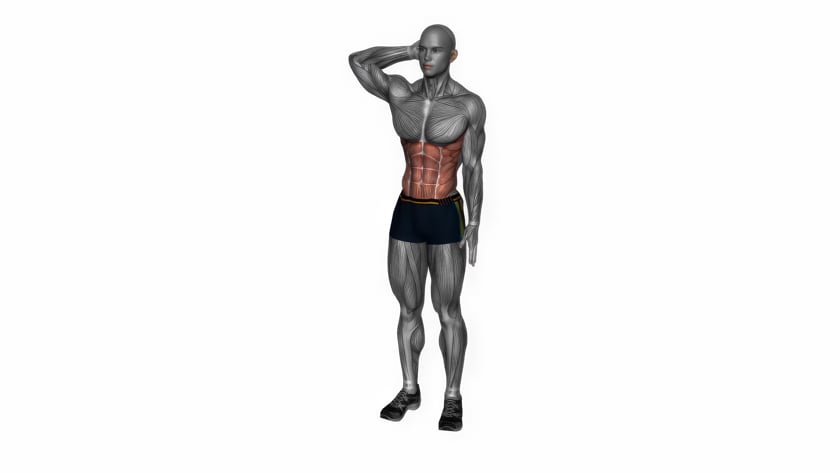
The Standing Side Stretch is a basic flexibility exercise used to stretch the muscles along the sides of the torso.
It involves lateral flexion, or gently bending the trunk to one side, and requires no equipment.
The video animation demonstrates a single-arm standing lateral stretch variation. The exerciser stands upright with one hand positioned behind the head and the opposite arm relaxed alongside the body.
The torso then bends laterally toward the side of the lowered arm before returning to an upright position. The movement is repeated to stretch the opposite side. The animation highlights the lateral abdominal and trunk region, particularly the oblique area.
This version differs slightly from standing side stretches in which both arms are extended overhead. However, the fundamental movement is the same: controlled lateral flexion of the torso creates a stretch through the opposite side of the trunk.
The hand-behind-head position shown in the video also keeps the exercise simple and eliminates the need for extensive overhead shoulder mobility.
The stretch should be performed as a gentle side bend rather than a twisting or forward-bending movement.
How to Perform
Stand upright with your feet approximately hip- to shoulder-width apart.
Maintain a slight, comfortable bend in the knees and distribute your weight evenly between both feet.
Place one hand behind your head with the elbow pointing comfortably outward.
Allow the opposite arm to remain relaxed alongside your body.
Keep your chest facing forward and gently engage the abdominal muscles to help maintain control of the torso.
Slowly bend your upper body toward the side of the lowered arm.
Allow the lowered hand to move naturally down the outside of the thigh as the torso bends.
Continue only until you feel a comfortable stretch along the opposite side of your torso.
Keep both feet planted and avoid rotating the shoulders or hips.
Hold the position while breathing normally, then slowly return to an upright position and repeat on the opposite side.
We recommend a hold of approximately 10–30 seconds.
Tips
Think about making your spine long before gently bending to the side.
Keep the chest facing forward. The movement should primarily be a side bend rather than a forward bend or torso rotation.
Keep both feet firmly planted and avoid shifting excessive weight onto one leg.
The hand behind the head should rest lightly. Do not pull or push on the head or neck to increase the stretch.
Keep the neck comfortable and generally aligned with the rest of the spine.
Move only far enough to feel gentle to moderate tension along the side of the torso. A deeper side bend is not necessarily a better stretch.
Keep the hips relatively centered rather than pushing them dramatically in the opposite direction.
Breathe normally and avoid bouncing.
Benefits
The Standing Side Stretch helps maintain or improve flexibility through the lateral muscles and connective tissues of the torso.
The exercise primarily lengthens tissues along the side opposite the direction of the bend. This can include the internal and external obliques and portions of other lateral trunk musculature.
The oblique muscles contribute to lateral flexion and rotation of the trunk as well as stabilization of the torso. Maintaining comfortable mobility through this region can support everyday movements involving reaching, bending and changing body position.
The exercise introduces gentle movement of the spine in the frontal plane, complementing stretches that primarily involve forward, backward or rotational movements.
Because the video variation uses only one arm behind the head, it does not require both shoulders to move into a fully overhead position. This can make the movement more accessible for some beginning exercisers.
The exercise requires no equipment and very little space, making it practical for home exercise, personal-training studios and general flexibility routines.
Common Mistakes
Rotating the torso while bending sideways changes the movement. Keep the chest facing generally forward throughout the stretch.
Leaning forward instead of directly to the side can reduce the intended lateral trunk stretch.
Pulling on the head with the hand can place unnecessary stress on the neck. The hand should rest lightly behind the head.
Trying to reach too far down the leg can encourage excessive spinal movement. Use only the range needed to create comfortable tension.
Allowing one or both feet to lift from the floor reduces stability. Keep both feet planted.
Shifting the hips dramatically to the opposite side can turn the exercise into a different stretch. Maintain a relatively centered lower body.
Holding the breath can increase unnecessary tension. Continue breathing normally throughout the stretch.
Bouncing or repeatedly forcing the torso deeper into the side bend is unnecessary. Static stretching should be slow and controlled.
FAQ
Safety Note
Perform the Standing Side Stretch on a stable, nonslip surface and maintain a balanced stance throughout the exercise.
Move slowly into and out of the side bend. Do not bounce or force the torso beyond a comfortable range of motion.
Keep the hand behind the head relaxed and never pull on the head or neck.
Maintain control through the torso and avoid combining the side bend with aggressive twisting, forward bending or excessive lower-back arching.
People who have difficulty with standing balance may perform the stretch near a stable support or use an appropriate seated variation.
Stop the stretch if you experience sharp pain, numbness, tingling, dizziness or unusual discomfort in the back, neck, hips or abdominal region.
If you have a recent or existing injury involving the spine, lower back, neck, ribs or abdominal muscles, consult your physician or another qualified healthcare professional before performing this or any other stretch.