
Standing Adductor Stretch
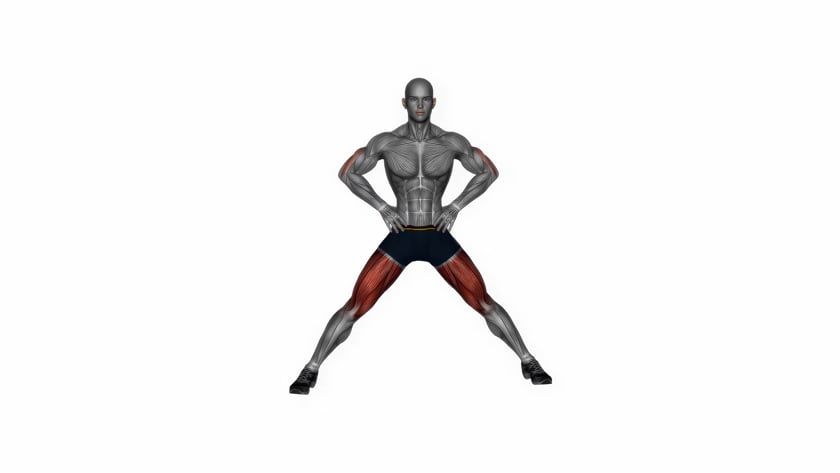
The Standing Adductor Stretch is a basic flexibility exercise used to stretch the adductor muscles along the inner thigh.
It is performed from a wide standing position and can be used either as a held static stretch or as a controlled side-to-side mobility movement.
The video animation demonstrates a dynamic alternating version of the Standing Adductor Stretch rather than a single static hold. The exerciser stands with the feet wider than shoulder-width apart, keeps one leg straight and bends the opposite knee while shifting the hips toward the bent-knee side.
The movement then returns through the center and repeats to the opposite side. This creates a stretch through the inner thigh of the straight leg.
Because the animation alternates continuously from side to side, it can also be viewed as a dynamic mobility variation.
How to Perform
Stand upright with your feet wider than shoulder-width apart.
Position the toes generally forward or slightly outward according to what feels comfortable.
Place your hands on your hips and keep your torso tall.
Gently engage your abdominal muscles to help maintain a stable trunk.
Shift your hips toward one side while bending that knee.
Keep the opposite leg straight and maintain the foot in contact with the floor.
Continue shifting until you feel a gentle stretch along the inner thigh of the straight leg.
Keep the chest lifted and avoid excessively rounding or twisting the torso.
Push gently through the bent leg to return to the center.
Repeat the movement to the opposite side.
To perform the exercise as demonstrated in the video, alternate slowly and smoothly from side to side. To use it as a static flexibility exercise, pause in the stretched position and hold before returning to the center.
We recommend holding the stretched position for approximately 15–30 seconds and repeating it 2–3 times per side.
Tips
Begin with a moderate stance width. A wider stance does not automatically create a better stretch.
Keep the foot of the straight leg firmly planted and avoid allowing the knee to collapse inward.
Shift the hips sideways rather than bending the torso toward the straight leg.
Keep the chest lifted and maintain a long spine throughout the movement.
Move only far enough to feel gentle to moderate tension along the inner thigh.
If using the dynamic version shown in the video, move slowly and under control rather than bouncing rapidly from side to side.
If using the exercise as a static stretch, settle into the position and breathe normally rather than repeatedly pulsing deeper.
We caution against excessive torso rotation, poor balance and aggressive overstretching during the Standing Adductor Stretch.
Benefits
The Standing Adductor Stretch helps maintain or improve flexibility through the inner thigh and groin region.
The hip adductors help move the thigh toward the body's midline and also contribute to control of the pelvis and leg during standing and single-leg movement.
Improving flexibility in the adductor region can support comfortable lateral movement and hip mobility.
The Standing Adductor Stretch can help improve hip-abduction range of motion and overall hip mobility.
The exercise requires no equipment and can easily be incorporated into a flexibility routine, warm-up or cool-down depending on whether the dynamic or static version is used.
The dynamic version shown in the video also introduces controlled frontal-plane movement.
Common Mistakes
Bending both knees substantially reduces the stretch on the inner thigh of the extended leg. Keep one leg relatively straight as you shift to the opposite side.
Allowing the knee of the bent leg to collapse inward can reduce lower-body alignment.
Leaning the torso excessively toward the bent leg can shift the movement away from the hips. Keep the chest lifted and torso controlled.
Rotating the torso while shifting side to side can interfere with the intended stretch.
Moving too quickly through the alternating version can turn a controlled mobility exercise into a bouncing movement.
Trying to force a deeper range can create unnecessary strain through the groin or inner thigh.
Lifting the foot of the straight leg from the floor can reduce stability and change the position of the stretch.
Holding the breath can increase unnecessary tension. Maintain steady breathing throughout the exercise.
FAQ
Safety Note
Perform the Standing Adductor Stretch on a stable, nonslip surface and maintain a stance that allows you to remain balanced.
Move gradually from side to side and avoid forcing the hips farther than your comfortable range of motion.
Keep the bent knee aligned with the foot and avoid allowing it to collapse inward.
Do not bounce aggressively or attempt to force a deeper groin stretch.
Stop immediately if you experience sharp pain, a pulling sensation that feels excessive, numbness, tingling or unusual discomfort in the groin, hip or knee.
If you have a recent or existing injury involving the groin, hip, knee or lower back, consult your physician or another qualified healthcare professional before performing this or any other stretch.