
Standing Quadriceps Stretch
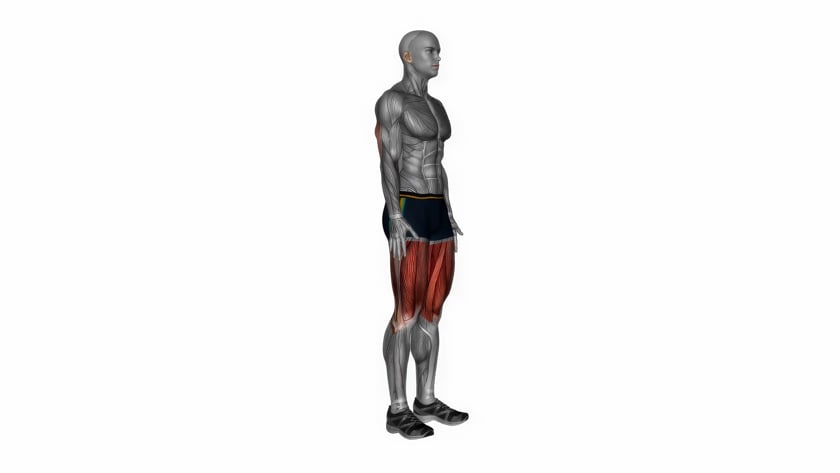
The Standing Quadriceps Stretch is a basic static flexibility exercise used to stretch the quadriceps muscles along the front of the thigh.
It requires no equipment and can be easily incorporated into a general flexibility or cool-down routine.
The video animation demonstrates the traditional single-leg standing quadriceps stretch. The exerciser balances on one leg, bends the opposite knee and brings the heel toward the buttocks while holding the raised foot with the hand on the same side. The torso remains upright and the knees stay relatively close together. This is an appropriate fundamental version for a beginning exercise library.
The quadriceps are a group of four muscles on the front of the thigh that extend the knee, while the rectus femoris also crosses the hip. Keeping the pelvis controlled and avoiding excessive arching of the lower back helps direct the stretch toward the front of the thigh.
How to Perform
Stand upright with your feet approximately hip-width apart.
Shift your weight onto one leg while maintaining a tall, balanced posture.
Bend the opposite knee and bring the heel upward toward your buttocks.
Reach down with the hand on the same side and gently hold the foot or ankle.
Keep the supporting knee relaxed rather than forcefully locking it.
Gently draw the heel toward the buttocks until you feel a comfortable stretch along the front of the thigh.
Keep the bent knee pointing generally toward the floor and close to the supporting leg rather than allowing it to move far out to the side.
Maintain an upright torso and gently engage the abdominal muscles to help control the pelvis and avoid excessive arching of the lower back.
Hold the stretch without bouncing while breathing normally.
Slowly release the foot, return to the starting position and repeat on the opposite side.
For general flexibility training, we recommend holding a static stretch for approximately 10–30 seconds and repeating it 2–4 times per muscle group.
Tips
Stand near a wall, sturdy chair or other stable object if additional balance assistance is needed. Beginners should prioritize a stable position over trying to perform the stretch without support.
Keep your torso tall throughout the stretch. Avoid leaning excessively forward, backward or to the side.
Keep the knees relatively close together. Allowing the bent knee to move far forward or outward can change the position of the stretch.
Gently engage the abdominal muscles and keep the pelvis controlled. Avoid arching the lower back in an attempt to pull the heel closer to the buttocks.
Pull the foot only far enough to feel gentle to moderate tension through the front of the thigh. More range is not necessarily better.
Hold the stretch steadily rather than bouncing or repeatedly pulling on the foot.
Breathe normally and allow the muscles to relax into the position.
Benefits
The Standing Quadriceps Stretch helps maintain or improve flexibility of the quadriceps muscles along the front of the thigh.
The quadriceps play an important role in extending the knee and are heavily involved in everyday activities and exercises such as walking, climbing stairs, standing from a seated position, squatting and lunging.
Because the rectus femoris crosses both the knee and hip, bending the knee while maintaining controlled hip and pelvic alignment can stretch this portion of the quadriceps across both joints.
The exercise is performed one leg at a time, allowing each side to be stretched independently and making differences in flexibility easier to recognize.
The Standing Quadriceps Stretch requires no equipment and very little space, making it practical for personal-training studios, home exercise and general post-workout flexibility routines.
Regular static stretching can contribute to improvements in flexibility and joint range of motion when incorporated consistently into an exercise program.
Common Mistakes
Arching the lower back excessively is a common compensation. Keep the abdominal muscles gently engaged and maintain a comfortable, relatively neutral pelvic position.
Pulling the heel aggressively toward the buttocks can create unnecessary stress at the knee. Move only far enough to produce a comfortable stretch through the front of the thigh.
Allowing the bent knee to move far out to the side changes body alignment. Keep the knees relatively close together and the bent knee pointing generally downward.
Leaning the torso forward or sideways to maintain balance reduces control of the stretch. Use a wall or sturdy support if necessary.
Forcefully locking the knee of the supporting leg can make the position less comfortable. Maintain a stable but relaxed supporting leg.
Grabbing the toes and forcefully pulling the foot can place unnecessary stress on the ankle. Hold the foot or ankle securely without excessive force.
Bouncing in and out of the stretch is unnecessary. Use a slow, controlled static hold.
FAQ
Safety Note
Perform the Standing Quadriceps Stretch on a stable, nonslip surface and use a wall or other secure support if needed for balance.
Move slowly into the stretch and stop when you feel gentle to moderate tension through the front of the thigh. Do not force the heel toward the buttocks or bounce while holding the position.
Maintain controlled alignment through the knee, hip, pelvis and lower back. Reduce the stretch if maintaining an upright posture becomes difficult.
Stop immediately if you experience sharp knee pain, hip pain, significant lower-back discomfort, dizziness or loss of balance.
If you have a recent or existing injury involving the quadriceps, knee, hip or lower back, consult your physician or another qualified healthcare professional before performing this or any other stretch.