
Standing Hamstring Stretch
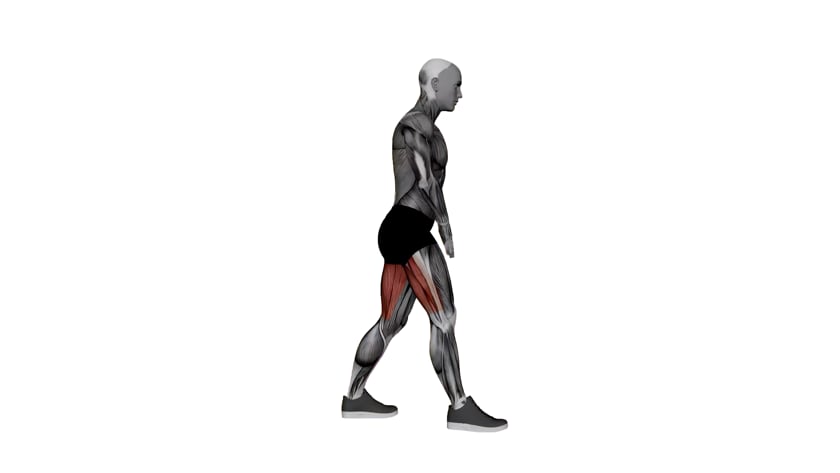
The Standing Hamstring Stretch is a basic static flexibility exercise used to stretch the hamstring muscles along the back of the thigh.
It requires no equipment and can be easily incorporated into a general flexibility or cool-down routine.
The video animation demonstrates a staggered-stance, straight-leg version of the Standing Hamstring Stretch. One leg is positioned forward with the knee straight and heel on the floor while the opposite knee bends slightly. The hips move backward and the torso inclines forward to create the stretch through the hamstrings of the forward leg.
This positioning is important because the movement should come primarily from the hips rather than by excessively rounding the lower back.
How to Perform
Stand upright with your feet approximately hip-width apart.
Step one foot forward into a comfortable staggered stance.
Keep the heel of the forward foot on the floor and straighten the forward knee without forcefully locking it.
Keep the rear foot firmly planted and bend the rear knee slightly.
Engage your abdominal muscles gently to help maintain a stable torso.
Push your hips backward while hinging forward from the hips. Maintain a long, relatively neutral spine rather than rounding the back toward the forward leg.
Continue the hip hinge until you feel a gentle stretch along the back of the forward thigh.
Keep your hips facing generally forward and avoid twisting the torso.
Hold the position while breathing normally and without bouncing.
Slowly return to the starting position, switch legs and repeat the stretch on the opposite side.
For general flexibility training, we recommend holding a static stretch for approximately 10–30 seconds and repeating it 2–4 times per muscle group.
Tips
Think about moving your hips backward rather than trying to reach your hands toward your toes. This helps keep the movement focused at the hip.
Maintain a long spine as you hinge forward. Avoid deliberately rounding the back in an attempt to move farther into the stretch.
Keep the forward knee straight but relaxed. It does not need to be forcefully locked.
Only hinge forward far enough to feel gentle to moderate tension through the back of the thigh.
Keep both feet stable and maintain enough bend in the rear knee to remain balanced.
Breathe normally throughout the stretch. Avoid holding your breath.
Do not bounce or repeatedly force yourself deeper into the position. Static stretching should be controlled. We recommend holding beginner static stretches at mild tension rather than forcing the range of motion.
Benefits
The Standing Hamstring Stretch can help maintain or improve flexibility of the hamstring muscles, which run along the back of the thigh.
Hamstring flexibility contributes to comfortable movement at the hip and knee and is relevant to common activities such as walking, bending and many lower-body exercises.
Hamstrings, calves and hip flexors are important lower-extremity muscle groups to address with static stretching because mobility in these areas contributes to walking mechanics.
The standing staggered position allows the exerciser to stretch one leg at a time, making it easier to accommodate differences in flexibility between sides.
The exercise requires no equipment and very little space, making it practical for fitness studios, home exercise and post-workout flexibility routines.
Regular static stretching can help improve range of motion over time. We recommend static stretching after exercise or during dedicated flexibility sessions for most beginners.
Common Mistakes
Rounding the back excessively instead of hinging from the hips is one of the most important errors to avoid.
Trying to reach the toes can encourage unnecessary spinal rounding. The objective is to stretch the hamstrings, not to see how far the hands can reach.
Forcefully locking the forward knee can create unnecessary joint tension. Keep the leg straight but comfortable.
Bending the forward knee too much can reduce the hamstring stretch.
Moving too far or too quickly into the stretch can turn comfortable tension into pain. Gradually increase the hip hinge only as flexibility allows.
Rotating the hips or torso can change the position of the stretch. Keep the hips and shoulders facing generally forward.
Bouncing at the end of the movement is unnecessary and can make the stretch more difficult to control.
FAQ
Safety Note
Perform the Standing Hamstring Stretch on a stable, nonslip surface and maintain a stance that allows you to remain balanced.
Move slowly into the stretch and stop when you feel gentle to moderate tension. Do not bounce or force yourself farther into the position.
Avoid aggressively rounding the lower back or pulling the torso toward the forward leg. Maintain a controlled hip hinge and comfortable spinal position.
Use a wall, chair or other stable support if additional assistance with balance is needed.
Stop the stretch if you experience sharp pain, numbness, tingling, dizziness or unusual discomfort.
If you have a recent or existing injury involving the hamstrings, hip, knee or lower back, consult your physician or another qualified healthcare professional before performing this or any other stretch.