
Stair Climber
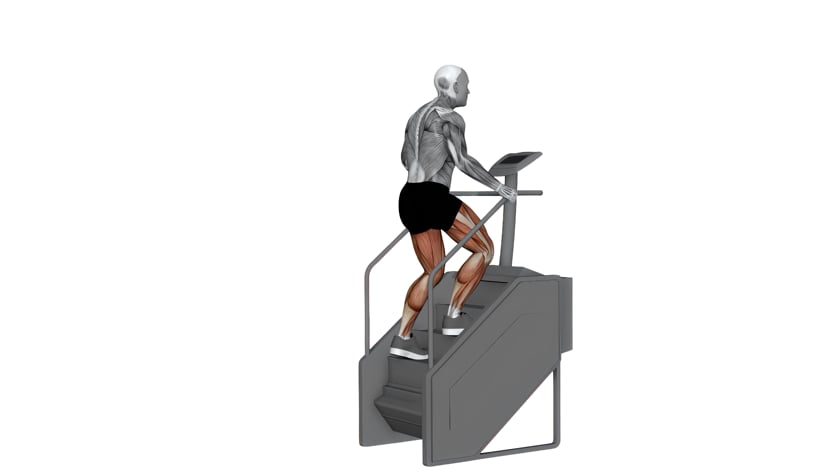
The Stair Climber is a stationary cardiovascular exercise machine that simulates continuously climbing a flight of stairs.
The repeated stepping action engages the large muscles of the lower body while increasing heart rate and breathing, making the machine useful for developing cardiorespiratory endurance and lower-body muscular endurance.
The video animation demonstrates a rotating-stair or StepMill-style Stair Climber, rather than a pedal-style stair stepper. The exerciser continuously climbs individual moving steps while maintaining an upright position and lightly holding the machine's handrails.
This distinction is useful because both types of equipment are sometimes referred to as stair climbers, but the movement shown in this exercise more closely resembles climbing an actual staircase.
How to Perform
Step carefully onto the machine and hold the handrails while positioning both feet securely on the steps.
Select a low starting speed or beginner program before allowing the stairs to begin moving.
Stand upright with your head facing forward, shoulders relaxed and abdominal muscles gently engaged.
Begin climbing by placing one foot on the next step and then following with the opposite foot in a natural alternating pattern.
Place enough of each foot on the step to maintain secure contact and balance.
Keep your torso upright while allowing a slight natural forward inclination from the ankles if needed. Avoid bending excessively forward at the waist.
Use the handrails lightly for balance rather than supporting a large portion of your body weight through your arms.
Maintain a smooth, controlled stepping rhythm and breathe continuously.
Adjust the machine speed gradually until you reach an appropriate cardiovascular intensity.
When finishing the workout, gradually reduce the machine speed and continue stepping at an easier pace before stopping completely.
Tips
Begin at a slow stepping speed until you become comfortable with the movement of the rotating stairs.
Keep your head up and look primarily forward rather than continuously looking down at your feet.
Place each foot securely on the step before transferring your body weight.
Maintain an upright posture and avoid leaning heavily onto the handrails.
Use the handrails primarily for balance. Excessively supporting your body with your arms changes the stepping movement and reduces the amount of body weight the legs must move.
Take comfortable, controlled steps rather than attempting to climb as rapidly as possible.
Beginners should first increase exercise duration gradually before making large increases in stepping speed.
Monitor your effort throughout the exercise.
Benefits
The Stair Climber provides continuous cardiovascular exercise using the large muscles of the lower body.
The repeated climbing movement primarily involves the quadriceps and gluteal muscles, with the hamstrings and calf muscles contributing as the body is repeatedly raised from one step to the next.
Because stair climbing requires repeatedly moving the body upward against gravity, the exercise also challenges lower-body muscular endurance.
The Stair Climber allows cardiovascular workload to be easily modified by changing stepping speed and exercise duration, making it adaptable to different conditioning levels.
The exercise requires coordination and balance as body weight repeatedly transfers from one leg to the other.
The machine is particularly useful in a studio environment because it provides continuous stair-climbing exercise in a compact, controlled indoor setting.
Common Mistakes
Beginning at a stepping speed that is too fast can cause a beginner to lose rhythm, rely excessively on the handrails or compromise foot placement.
Leaning heavily onto the handrails reduces the amount of body weight supported by the legs and can encourage poor exercise posture.
Bending excessively forward at the waist can place the body in an unnecessarily hunched position. Keep the torso comfortably upright.
Taking very short steps while allowing the heels to remain unsupported can make the movement less stable. Place the foot securely on each stair whenever possible.
Looking continuously downward can encourage a rounded upper-body posture and may interfere with balance.
Allowing the knees to repeatedly collapse inward while climbing can reduce lower-body alignment and control.
Increasing machine speed before developing a comfortable stepping rhythm can make the exercise unnecessarily difficult.
Stopping abruptly after a challenging cardiovascular effort should be avoided. Gradually reduce the stepping speed before finishing the workout.
FAQ
Safety Note
Become familiar with the machine controls and emergency stop procedure before beginning the exercise.
Use the handrails when getting onto or off the machine, and begin at a slow speed until you are comfortable with the moving stairs.
Maintain secure foot placement on each step and avoid stepping too close to the edge of the stair.
Do not increase the speed beyond a level at which you can maintain an upright posture, controlled stepping pattern and good balance.
Reduce the speed or stop the exercise if fatigue causes you to stumble, miss steps or rely heavily on the handrails for support.
Individuals with balance difficulties or existing knee, hip, ankle or other orthopedic problems may need a different cardiovascular exercise or an appropriately modified program.
Stop exercising if you experience pain, dizziness, unusual shortness of breath, chest discomfort or other concerning symptoms. ACSM professional guidance emphasizes monitoring signs, symptoms and physiological response during exercise and modifying exercise when adverse responses occur.
Individuals with cardiovascular, respiratory, orthopedic or other medical conditions should follow the exercise recommendations provided by their physician or another qualified healthcare professional.