
Low Step-Up
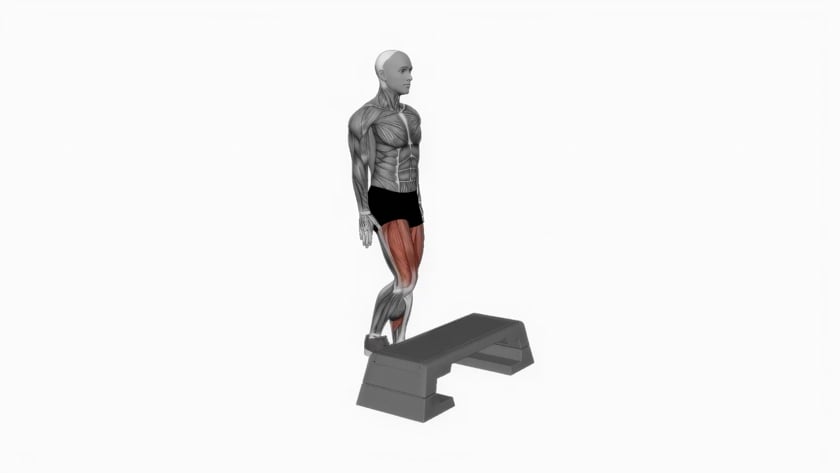
The Low Step-Up is a simple body-weight cardiovascular exercise performed by repeatedly stepping onto and off a low, stable platform. T
he exercise uses the large muscles of the lower body while providing a straightforward way to increase heart rate and breathing without the jumping or running movements associated with higher-impact cardio exercises.
The video animation demonstrates a continuous alternating step-up onto a low aerobic-style platform. The exerciser steps completely onto the platform, brings the opposite foot up, and then steps back down before repeating the movement.
Because the platform shown is relatively low, this variation is particularly appropriate for beginning exercisers as a cardiovascular fundamental basic exercise.
How to Perform
Stand upright facing a low, stable exercise step with your feet approximately hip-width apart.
Keep your head facing forward, shoulders relaxed and abdominal muscles gently engaged.
Place one entire foot securely on top of the platform.
Shift your weight onto the lead foot and press through that foot to raise your body onto the platform.
Bring the opposite foot onto the platform so that you briefly finish with both feet securely supported.
Step back down with one foot, followed by the other, returning to the floor under control.
Repeat the movement in a steady rhythm. Alternate the lead leg periodically so both legs perform the stepping action.
Keep your torso upright and avoid using excessive momentum or pushing forcefully from the foot that remains on the floor.
Continue stepping at a pace appropriate for your fitness level while maintaining steady breathing.
When finishing the exercise, gradually slow your stepping pace before stopping.
Tips
Start with a low platform.
Place the entire foot on the platform rather than allowing the heel to hang over the edge.
Keep your head up and torso comfortably upright throughout the movement.
Press through the foot on the platform instead of aggressively pushing off with the trailing foot.
Step down under control rather than dropping quickly from the platform.
Maintain a comfortable, consistent rhythm. For cardiovascular training, smooth continuous movement is more important than performing the exercise as quickly as possible.
Alternate the lead leg regularly to distribute the workload between both sides of the body.
Beginners should first become comfortable with the stepping pattern before increasing pace, duration or platform height.
Benefits
The Low Step-Up provides cardiovascular exercise using minimal equipment and floor space, making it practical for personal-training studios, group exercise settings and home workouts.
Repeated stepping uses large muscles of the lower body, particularly the quadriceps and gluteal muscles, while the hamstrings, calves and hip musculature assist with movement and stabilization.
The exercise also develops basic coordination and balance because the exerciser repeatedly transfers body weight between the floor and an elevated surface.
Unlike jumping onto a box, the Low Step-Up maintains controlled foot contact and does not require an explosive takeoff or landing. This makes it easier to scale for beginning and deconditioned exercisers.
The cardiovascular demand can be modified without changing the basic movement. Exercise duration and stepping cadence can be gradually increased as conditioning improves.
We recommend monitoring aerobic exercise intensity using methods such as the talk test and perceived exertion.
Common Mistakes
Using a platform that is too high can make it difficult for a beginner to maintain balance and good stepping mechanics. Begin with a low step and progress gradually.
Placing only the front portion of the foot on the platform can reduce stability.
Pushing excessively from the trailing leg instead of allowing the lead leg to perform the majority of the upward work is another common error.
Leaning excessively forward while stepping up can interfere with posture and balance.
Allowing the knee of the lead leg to collapse inward reduces lower-body alignment and control.
Looking continuously downward at the platform can encourage a rounded posture. Briefly check foot placement when necessary, but otherwise keep the head comfortably upright.
Stepping too quickly can lead to incomplete foot placement or loss of balance. Maintain a pace that allows every step to be controlled.
Always leading with the same leg for prolonged periods can unnecessarily favor one side. Alternate the lead leg regularly.
FAQ
Safety Note
Use only a stable exercise step or platform placed on a flat, nonslip surface.
Make sure the entire foot is securely positioned on the platform before transferring your body weight onto it.
Begin with a low platform and a slow, controlled pace until you are comfortable with the movement.
Maintain an upright posture and avoid rushing the stepping pattern. If necessary, perform the exercise near a stable support until balance and confidence improve.
Reduce the pace or stop the exercise if fatigue causes you to miss the platform, lose balance or lose control of the stepping movement.
Stop exercising if you experience pain, dizziness, unusual shortness of breath, chest discomfort or other concerning symptoms.
Individuals with cardiovascular, respiratory, balance, knee, hip, ankle or other orthopedic conditions should follow the exercise recommendations provided by their physician or another qualified healthcare professional.