
Squat - Overhead Reach
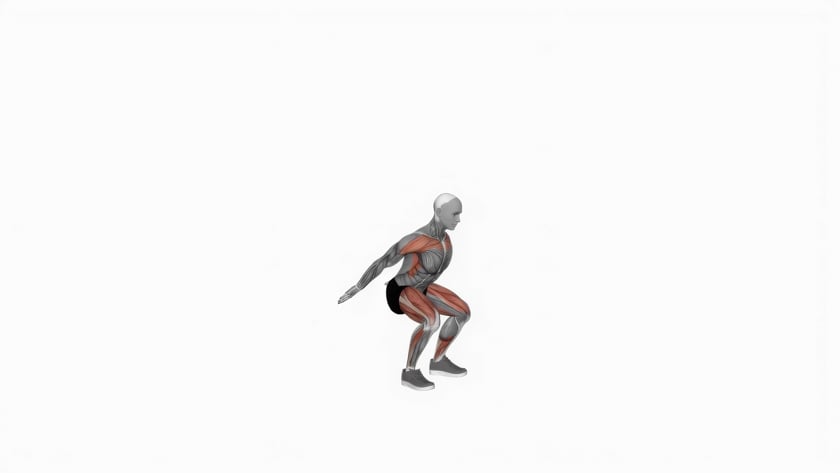
The Squat - Overhead Reach is a body-weight cardiovascular exercise that combines a basic squat pattern with a large, coordinated arm movement.
The exercise uses the major muscles of the lower body while the arms travel overhead as the body returns to standing. When performed continuously at a comfortable rhythmic pace, the combination creates a simple full-body movement that can increase heart rate and breathing without requiring specialized equipment.
The video animation demonstrates a continuous partial squat with a dynamic arm swing and overhead reach. The exerciser bends the hips and knees while swinging both arms downward and slightly behind the body, then stands and swings both arms forward and overhead.
The movement immediately repeats in a smooth rhythm. This is therefore somewhat different from a traditional strength-focused body-weight squat and is included in the Cardio library because of the continuous, repetitive full-body movement.
The Squat - Overhead Reach is a well-established movement pattern especially well suited for beginning exercises.
How to Perform
Stand upright with your feet approximately hip- to shoulder-width apart and your arms relaxed by your sides.
Keep your head facing forward, shoulders relaxed and abdominal muscles gently engaged.
Begin the squat by bending your hips and knees and allowing your hips to move back and downward.
As you lower into the squat, swing both arms downward and slightly behind your body as demonstrated in the video.
Descend only as far as you can comfortably while maintaining balance and control. A deep squat is not required for this cardiovascular variation.
Press through your feet and extend your hips and knees to return to standing.
As you rise, swing both arms forward and upward until they reach comfortably overhead.
Return immediately into the next squat while allowing the arms to swing downward again.
Continue alternating between the squat and overhead reach in a smooth, rhythmic pattern while breathing continuously.
Tips
Begin with a shallow squat and slow rhythm until you are comfortable coordinating the lower-body movement with the arm swing.
Keep your feet firmly planted throughout the exercise.
Allow your knees to track generally in the same direction as your feet rather than collapsing inward.
Keep your chest comfortably lifted as you squat rather than rounding excessively through the back.
Use a squat depth appropriate for your mobility and fitness level. We recommend that beginning exercisers start with the body-weight squat and develop the basic movement before progressing to more challenging variations.
Reach overhead only as far as your shoulder mobility comfortably allows. The arms do not need to travel directly overhead if doing so causes discomfort.
Use the arm swing to create a smooth whole-body rhythm rather than forcefully throwing the arms.
For a deconditioned beginner, start with a smaller range of motion and slower pace. Gradually increase duration, pace or squat depth as conditioning and movement proficiency improve.
Benefits
The Squat - Overhead Reach provides a full-body conditioning movement that requires no specialized exercise equipment and very little floor space, making it particularly useful in personal-training studios.
The squat portion primarily involves the quadriceps and gluteal muscles, with the hamstrings and other lower-body muscles contributing to the movement and stabilization.
The overhead arm movement involves the shoulders and upper body while the core helps maintain trunk stability as the body repeatedly transitions between the squat and standing positions.
Performing the exercise continuously incorporates large muscle groups into a rhythmic whole-body activity, allowing it to function as a cardiovascular conditioning exercise when performed for an appropriate duration and pace.
The movement can be easily modified for different fitness levels. A deconditioned exerciser can use a shallow squat, smaller arm movement and slower cadence, while a more conditioned exerciser can gradually increase the pace or range of motion.
Common Mistakes
Squatting too deeply before developing adequate mobility and control can cause technique to deteriorate. Use a comfortable depth appropriate for the individual.
Allowing the knees to collapse inward during the squat reduces lower-body stability.
Bending primarily through the knees without allowing the hips to move backward can interfere with a comfortable squat pattern.
Rounding excessively through the back while lowering into the squat can compromise posture. Keep the torso controlled throughout the movement.
Forcefully arching the lower back while reaching overhead can occur when shoulder mobility is limited. Maintain abdominal control and reduce the height of the arm reach if necessary.
Moving too quickly can cause the exercise to become uncontrolled. Establish good squat mechanics and arm coordination before increasing the pace.
Holding the breath is unnecessary during this cardiovascular movement. Maintain steady breathing throughout the exercise.
FAQ
Safety Note
Perform the exercise on a stable, nonslip surface with enough overhead clearance for the arm movement.
Begin with a shallow squat and comfortable arm range until you are familiar with the exercise.
Keep your feet firmly planted, maintain control of the knees and avoid using momentum to force a deeper squat or larger overhead reach.
Individuals with limited shoulder mobility should reduce the overhead range rather than forcing the arms into an uncomfortable position.
Reduce the pace, range of motion or exercise duration if fatigue causes loss of squat technique or balance.
Stop exercising if you experience sharp pain, dizziness, unusual shortness of breath or other concerning symptoms.
Individuals with cardiovascular, respiratory, orthopedic or other medical conditions should follow the exercise recommendations provided by their physician or another qualified healthcare professional.