
Jumping Jacks
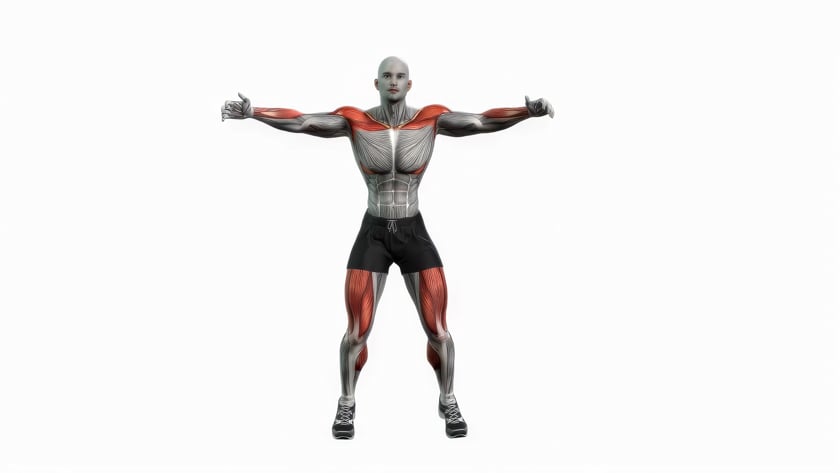
Jumping Jacks are a fundamental body-weight cardiovascular exercise that combines repeated jumping with coordinated arm and leg movement.
From a standing position, the feet jump outward as the arms travel overhead, then the feet return together as the arms lower to the sides.
When performed continuously, the movement quickly increases heart rate and breathing while requiring no specialized equipment.
The video animation demonstrates the traditional two-foot Jumping Jack. The exerciser begins with the feet together and arms at the sides, jumps both feet outward while simultaneously raising the arms overhead, and then reverses the movement to return to the starting position.
How to Perform
Stand upright with your feet together and your arms relaxed at your sides.
Gently brace your abdominal muscles and maintain an upright posture.
Jump both feet outward to approximately shoulder-width or slightly wider.
At the same time, sweep both arms outward and upward until your hands approach one another overhead.
Land softly with both knees slightly bent to help absorb the impact.
Immediately jump both feet back together while lowering your arms along the same path toward your sides.
Land softly again and return to the starting position.
Continue repeating the movement in a smooth, rhythmic pattern while maintaining steady breathing.
We emphasize coordinating the arm and leg movements, maintaining upright posture and landing under control rather than using jerky or uncontrolled movements.
Tips
Start slowly until you become comfortable coordinating the arms and legs.
Land softly with a slight bend in the knees rather than landing with the legs completely straight. We emphasize soft, controlled landings during Jumping Jacks.
Keep your torso upright and your abdominal muscles gently engaged throughout the exercise.
Use a comfortable width when jumping the feet apart. There is no need to force an excessively wide stance.
Move the arms through a comfortable range of motion. Individuals with limited shoulder mobility can reduce how far overhead the arms travel.
Maintain a steady rhythm rather than performing the repetitions as quickly as possible.
For a lower-impact version, perform a Step Jack by stepping one foot outward at a time while raising the arms, then stepping back to the starting position.
Exercise intensity can be monitored with the talk test or perceived exertion.
Benefits
Jumping Jacks provide cardiovascular exercise without requiring machines or other specialized equipment, making them particularly useful in personal-training studios and other small exercise spaces.
The continuous movement engages large muscle groups and can rapidly increase heart rate, creating a cardiovascular training stimulus.
The exercise uses the quadriceps and gluteal muscles during the repeated jumping action, with assistance from the hamstrings and calf muscles. The shoulders move the arms overhead while the core helps stabilize the body.
Jumping Jacks also develop basic coordination because the arms and legs must move together in a repeated rhythmic pattern.
The exercise can be easily modified for different fitness levels. A beginner or deconditioned exerciser can start with Step Jacks, while someone with greater conditioning can progress to traditional Jumping Jacks.
Common Mistakes
Landing with the knees completely straight can increase impact stress.
Landing heavily rather than softly increases unnecessary impact through the feet, ankles, knees and hips.
Moving too quickly can cause coordination and landing mechanics to deteriorate. NASM cautions against sacrificing form for speed or repetition count.
Allowing the knees to collapse inward when the feet land apart can reduce lower-body stability.
Excessively arching the lower back as the arms move overhead can interfere with good posture. Keep the abdominal muscles gently engaged and use a comfortable arm range.
Holding the breath can make the exercise unnecessarily difficult. Maintain regular breathing throughout the movement.
Continuing traditional Jumping Jacks after fatigue begins to compromise landing mechanics is another common mistake. Reduce the pace, rest or switch to the Step Jack variation when necessary.
FAQ
Safety Note
Perform Jumping Jacks on a stable, nonslip surface with enough space overhead and around your body for unrestricted arm and leg movement.
Land softly with the knees slightly bent and maintain control throughout every repetition.
Beginners and deconditioned exercisers should start slowly. Use the lower-impact Step Jack variation when repeated jumping is uncomfortable or difficult to control.
Stop the exercise or switch to a lower-impact variation if fatigue causes heavy landings, poor balance or loss of movement control.
Individuals with existing foot, ankle, knee, hip or other joint problems may need to avoid repeated-impact jumping or use an appropriate low-impact modification.
Stop exercising if you experience sharp pain, dizziness, unusual shortness of breath or other concerning symptoms.
Individuals with cardiovascular, respiratory, orthopedic or other medical conditions should follow the exercise recommendations provided by their physician or another qualified healthcare professional.