
Treadmill Walk
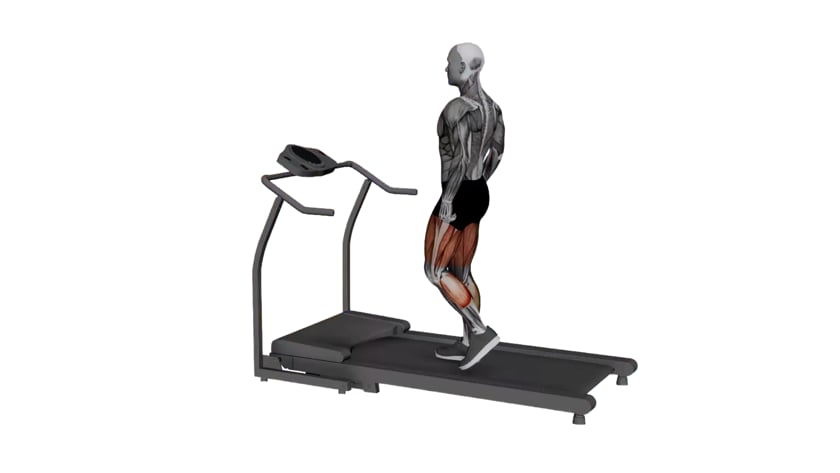
The Treadmill Walk is a fundamental cardiovascular exercise that uses a motorized treadmill to provide a controlled and predictable walking environment.
Walking is a low-impact aerobic activity that can be appropriate for beginners and de-conditioned exercisers because speed, duration and treadmill incline can be adjusted to match the individual's current fitness level.
The accompanying video animation demonstrates continuous walking on a level treadmill with an upright posture and natural walking stride. The anatomical illustration highlights the lower-body musculature involved in walking.
Although these muscles produce and stabilize the movement, the primary purpose of the exercise in this library is cardiovascular conditioning rather than isolated muscular strengthening.
For beginning exercisers, treadmill walking offers the additional advantage of allowing you to precisely control speed and gradually increase workload. Once your are comfortable walking on a level treadmill, speed, duration or incline can be progressively adjusted to increase cardiovascular demand.
How to Perform
Begin by standing on the treadmill with the machine stopped or operating at its lowest practical speed.
Familiarize yourself with the treadmill controls, including the start, stop and emergency-stop features, before increasing the speed.
Begin walking slowly and establish a comfortable, balanced stride.
Gradually increase the treadmill speed until you reach the desired walking pace.
Keep your head up, eyes looking forward and shoulders relaxed. Maintain an upright torso rather than leaning forward or backward.
Allow your arms to swing naturally alongside your body in opposition to the legs.
Walk near the center of the treadmill belt rather than drifting too close to the front or rear of the machine.
Maintain a natural stride and place each foot comfortably on the moving belt.
Continue walking for the planned duration while maintaining a pace appropriate for your fitness level.
At the end of the workout, gradually decrease the treadmill speed and walk slowly for a brief cool-down before stopping the machine.
Tips
Start with a slow speed until you become comfortable with the moving treadmill belt. Beginners should prioritize balance, posture and a natural walking pattern before increasing intensity.
Avoid continuously supporting your body weight with the handrails. The rails can be used briefly when getting accustomed to the treadmill or when additional stability is needed, but normal walking should allow the arms to swing naturally when it is safe to do so.
Increase speed gradually rather than making large, sudden adjustments.
Use the talk test or rating of perceived exertion to help monitor cardiovascular intensity.
Incline can eventually be added to increase exercise intensity without requiring the exerciser to run. Beginners should first become comfortable walking on a level treadmill before substantially increasing the grade.
Benefits
Treadmill walking develops cardiorespiratory endurance by requiring sustained activity of the large muscles of the lower body.
Walking is a low-impact cardiovascular exercise and generally places less stress on the joints than higher-impact activities such as running.
The treadmill provides a consistent surface and allows precise control of walking speed, making exercise intensity easier to reproduce and progressively adjust.
Speed and incline can be modified independently, allowing trainers to tailor the exercise to a wide range of fitness levels and gradually progress the workload as conditioning improves.
Treadmill walking can also provide a convenient indoor alternative when weather, terrain or other environmental conditions make outdoor walking impractical.
Common Mistakes
Starting at a speed that is too fast can interfere with balance and walking mechanics. Begin conservatively and increase speed only after establishing a comfortable stride.
Holding tightly to the handrails throughout the exercise can change normal walking mechanics and reduce natural arm movement. Use the rails for balance when necessary, but avoid depending on them when you can walk safely without support.
Walking too close to the front of the treadmill may restrict natural arm and leg movement. Position yourself comfortably near the center of the walking area.
Looking down continuously at the belt or feet may encourage poor posture. Keep your head upright and direct your eyes primarily forward.
Taking excessively long strides can make treadmill walking less comfortable and may interfere with a natural gait. Allow your stride length to remain comfortable for the selected speed.
Increasing speed or incline too quickly can create unnecessary fatigue and may be particularly inappropriate for a deconditioned beginner.
Stopping suddenly after a sustained cardiovascular effort should be avoided. Reduce the speed and allow a brief period of easier walking before finishing.
FAQ
Safety Note
Become familiar with the treadmill controls and emergency-stop system before beginning exercise. Start at a manageable speed, maintain a stable position on the belt and make speed or incline adjustments gradually.
Use a pace and duration appropriate for your current fitness level. Reduce the workload or stop exercising if you experience pain, dizziness, unusual shortness of breath, loss of balance or other concerning symptoms.
Individuals with cardiovascular, respiratory, orthopedic or other medical conditions should follow the exercise recommendations provided by their physician or another qualified healthcare professional.