
Standing Calf Raise
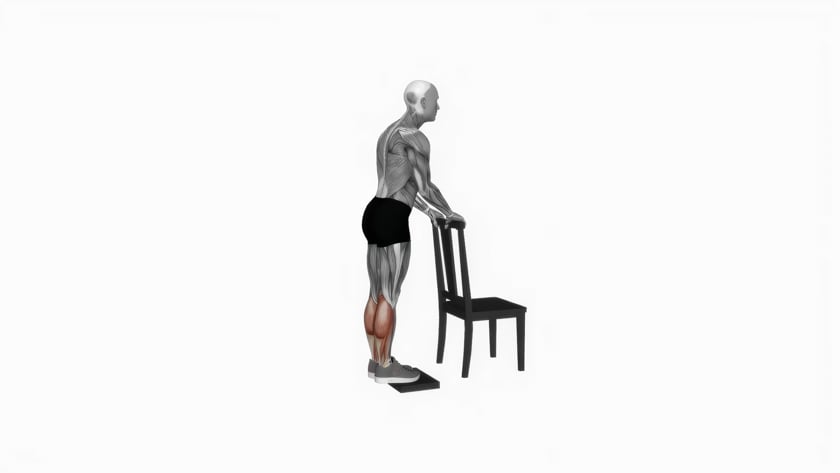
The Standing Calf Raise is a fundamental body-weight exercise that strengthens the muscles on the back of the lower leg, primarily the gastrocnemius with assistance from the soleus.
The movement occurs primarily at the ankle as the heels rise from the floor through plantar flexion and then lower under control.
The video animation demonstrates a body-weight Standing Calf Raise performed on a raised platform while lightly holding a chair for balance. The balls of both feet remain supported on the platform while the heels move upward and downward through a controlled range of motion. The chair is used for stability rather than to assist with lifting the body.
The straight-leg position shown in the video places particular emphasis on the gastrocnemius.
How to Perform
Stand on a secure raised platform with the balls of your feet supported and your heels extending beyond the edge.
Position your feet approximately hip-width apart with your toes pointing generally forward.
Lightly hold a stable support, such as the chair demonstrated in the video, to help maintain balance.
Stand tall with your abdominal muscles gently braced and keep your knees straight without forcefully locking them.
Slowly lower your heels below the level of the platform until you feel a comfortable stretch through the calves.
Press through the balls of your feet and raise your heels as high as comfortably possible.
Pause briefly at the top and contract your calf muscles.
Slowly lower your heels back toward the starting position under control.
Continue through a comfortable range of motion for the desired number of repetitions.
We recommend raising the heels until standing high on the toes, briefly contracting the calves at the top and then lowering slowly. When the exercise is performed from a step or raised surface, the heels can descend below the platform to increase the available range of motion.
Tips
Use a stable platform that will not slide or shift during the exercise.
Keep enough of the forefoot on the platform to maintain a secure position throughout each repetition.
Use the chair or another stable object only as much as necessary for balance. Avoid pulling or pushing with the arms to help raise your body.
Keep your feet approximately hip-width apart and your toes generally pointing forward.
Keep your knees relatively straight throughout the movement to maintain the emphasis on the gastrocnemius.
Rise smoothly onto the balls of your feet rather than bouncing upward.
Pause briefly at the top and consciously contract the calf muscles.
Lower the heels slowly and under control. We caution against fast, bouncing repetitions because they can rely more heavily on elastic energy from the Achilles tendon rather than controlled muscular effort.
Use a comfortable range of motion. The heels can descend below the platform, but there is no need to force an excessive stretch.
Benefits
The Standing Calf Raise strengthens the gastrocnemius and soleus, the two prominent muscles of the calf complex. Both contribute to plantar flexion of the ankle, the movement that occurs when you rise onto the balls of your feet.
The straight-leg position particularly emphasizes the gastrocnemius because this muscle crosses both the knee and ankle. NASM distinguishes straight-leg calf exercises, such as the Standing Calf Raise, from bent-knee variations that place relatively greater emphasis on the soleus.
Strengthening the calf complex supports movements involving the ankle during everyday and recreational activities, including walking, climbing stairs and rising onto the toes. The calf muscles also contribute to more demanding movements such as running and jumping.
The body-weight version requires very little equipment and can be easily incorporated into a basic resistance-training program. ACSM's current resistance-training guidance recognizes body-weight exercises as an effective option and emphasizes that resistance training does not require complicated equipment to provide benefits.
The raised-platform variation demonstrated in the video also allows the heels to move below the level of the forefoot, providing a greater available range of motion than performing the exercise entirely on a flat floor.
Common Mistakes
Bouncing rapidly through the repetitions uses momentum and reduces muscular control. NASM recommends a controlled lowering phase and a deliberate contraction at the top rather than fast, bouncing repetitions.
Performing only a very short up-and-down movement limits the available range of motion.
Allowing the ankles to roll excessively inward or outward can reduce stability. Keep the pressure distributed through the forefoot and maintain controlled ankle alignment.
Bending the knees significantly changes the mechanics of the exercise and shifts relatively more emphasis toward the soleus.
Using the arms to push or pull against the support reduces the amount of work performed by the calves.
Dropping the heels rapidly during the lowering phase reduces muscular control.
Rising unevenly onto one foot can cause one leg to perform more work than the other.
Using an unstable platform or support creates an unnecessary balance and fall risk.
Lowering the heels farther than your comfortable ankle range allows can create unnecessary strain.
FAQ
Safety Note
Use a solid, nonslip platform that is designed to support your body weight.
Make sure the balls of both feet are securely positioned on the platform before beginning.
Use a stable chair, rail or other fixed support when additional balance assistance is needed.
Move slowly and avoid bouncing at either the top or bottom of the exercise.
Lower your heels only through a comfortable range of motion and do not force an excessive stretch.
Maintain control of your ankle position and avoid allowing the feet or ankles to roll excessively inward or outward.
Progress gradually if you later add external resistance. NASM advises gradual progression with calf training and cautions against sudden increases in training demand on the calf-Achilles complex.
Stop the exercise if you experience sharp, persistent or unusual pain in the foot, ankle, Achilles tendon or calf.
If you have an existing spinal injury or chronic back pain, consult your physician or another qualified healthcare professional before performing this or any other exercise.