
Seated Leg Extension
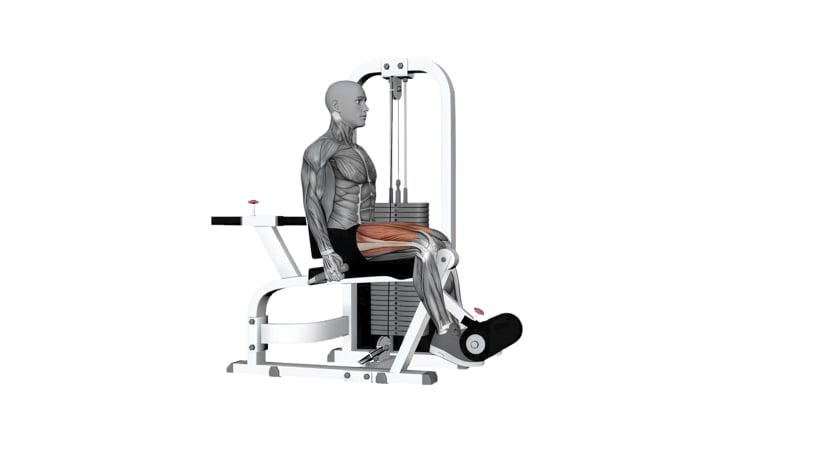
The Seated Leg Extension is a machine-based isolation exercise that primarily targets the quadriceps muscles on the front of the thighs.
Unlike squats, lunges and leg presses, which involve movement at both the hip and knee, the Leg Extension focuses primarily on knee extension, making it a simple way to directly train the quadriceps.
The video animation demonstrates the traditional bilateral Seated Leg Extension. The exerciser sits with the back supported against the machine, positions the lower legs behind the padded roller and extends both knees to raise the resistance. The legs are then lowered back to the starting position under control.
Because the machine guides the movement, the exercise requires relatively little balance or coordination. This makes it easy to understand and useful as a basic quadriceps isolation exercise.
How to Perform
Sit on the Leg Extension machine with your back comfortably supported against the back pad.
Adjust the seat so your knees are positioned close to the machine's pivot point. We specifically emphasize aligning the center of the knee with the machine's axis.
Position the lower-leg pad comfortably across the front of the lower legs near the ankles.
Sit tall with your hips and back remaining against the pads and grasp the handles, if provided, for stability.
Begin with your knees comfortably bent and your feet relaxed in a neutral position.
Brace your abdominal muscles gently and maintain a stable upper-body position.
Extend both knees in a smooth, controlled motion, raising the padded lever until the legs approach a comfortably straight position.
Pause briefly near the top while maintaining tension in the quadriceps.
Slowly bend the knees and lower the resistance back toward the starting position.
Maintain control throughout the lowering phase rather than allowing the weight stack to drop.
Repeat for the desired number of repetitions.
Tips
Take time to adjust the machine before beginning. Proper alignment between your knees and the machine's pivot point helps create a more comfortable movement path.
Position the lower-leg pad near the ankles rather than high on the shins.
Keep your hips and back in contact with the seat throughout the exercise.
Use a resistance that allows you to extend and lower the legs smoothly without swinging or generating momentum.
Think about contracting the quadriceps to straighten the knees rather than kicking the weight upward.
Move through a comfortable range of motion. There is no need to force the knees aggressively into their end range at the top.
Pause briefly as the legs approach extension and then lower the resistance slowly.
Avoid allowing the weight plates to slam together between repetitions.
Keep your breathing natural. Exhale as you extend your legs and inhale as you return to the starting position.
Benefits
The Seated Leg Extension directly targets the quadriceps, the group of four muscles located on the front of the thigh that are responsible for extending the knee.
Because it is a single-joint exercise, the movement allows the exerciser to concentrate specifically on quadriceps contraction without the balance requirements associated with exercises such as squats and lunges.
The machine provides a guided movement path and allows the resistance to be adjusted easily, making it straightforward to select an appropriate training load.
The exercise can complement compound lower-body movements such as squats, lunges, step-ups and leg presses by providing additional direct work for the quadriceps.
Common Mistakes
Using too much resistance can cause the exerciser to kick the weight upward or use momentum rather than controlling the movement with the quadriceps.
Failing to adjust the seat correctly can place the knees out of alignment with the machine's pivot point.
Positioning the roller pad too high on the lower legs can make the exercise uncomfortable and alter the intended mechanics.
Lifting the hips away from the seat during the extension reduces stability and may indicate that the resistance is too heavy.
Arching excessively through the lower back instead of maintaining contact with the backrest reduces upper-body stability.
Extending the knees aggressively at the top can place unnecessary stress on the joint. Use a smooth motion and avoid forcefully snapping the knees into extension.
Allowing the resistance to fall rapidly during the return phase removes much of the controlled muscular work from the exercise.
Using a range of motion that produces knee discomfort rather than adjusting the movement to a comfortable range is another common mistake.
FAQ
Safety Note
Adjust the machine before beginning so your knees align properly with the machine's pivot point and the lower-leg pad rests comfortably near the ankles.
Begin with a light resistance until you are familiar with the machine and can perform the movement smoothly.
Keep your hips and back supported against the seat throughout the exercise.
Use a slow, controlled motion during both the lifting and lowering phases.
Do not kick the weight upward, bounce at the bottom or forcefully snap the knees into extension.
Use only a comfortable, pain-free range of motion.
Individuals with existing knee injuries, anterior knee pain or a history of knee surgery may require modifications to the resistance or range of motion. NSCA notes that knee-extension loading can vary considerably across different joint angles and conditions.
Stop the exercise if you experience sharp, persistent or unusual pain in the knees, hips or lower back.
If you have an existing spinal injury or chronic back pain, consult your physician or another qualified healthcare professional before performing this or any other exercise.