
Body Weight Step-Up
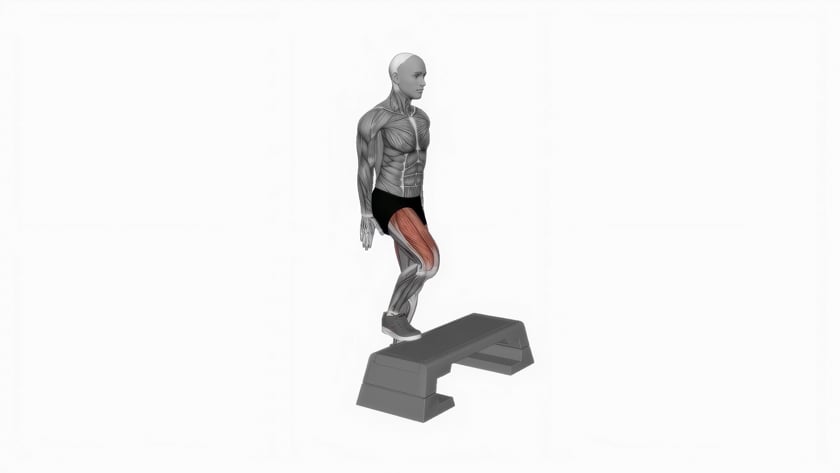
The Body Weight Step-Up is a fundamental lower-body exercise that strengthens the quadriceps and glutes while also engaging the hamstrings, calves and muscles that help stabilize the hips and core.
The exercise mimics the everyday movement of climbing stairs, making it a practical way to develop lower-body strength, balance and coordination.
In the video animation, the exerciser performs the movement using body weight and a raised platform. One foot is placed securely on the platform, the body is lifted until both feet reach the top and the exerciser then steps back down under control.
The movement alternates between legs. This straightforward variation is particularly appropriate for the Fundamental Core Exercise library because no additional resistance is required.
We emphasize placing the entire lead foot firmly on the platform, maintaining an upright torso and keeping the knee aligned with the foot.
How to Perform
Stand upright facing a stable step, bench or platform with your feet approximately hip-width apart.
Keep your chest lifted, shoulders relaxed and abdominal muscles gently braced.
Place one foot completely on top of the platform. Make sure the heel is supported rather than hanging over the edge.
Keep the knee of the lead leg aligned generally with the middle of the foot.
Shift your weight toward the lead leg and press through the foot to begin lifting your body.
Extend the hip and knee of the lead leg as you rise onto the platform.
Bring the trailing foot onto the platform beside the lead foot and stand tall at the top.
Begin the descent by stepping backward with the trailing leg.
Lower yourself under control until the trailing foot reaches the floor.
Step the lead foot back to the floor and return to the starting position.
Repeat with the opposite leg or continue alternating sides for the desired number of repetitions.
We emphasize controlled upward and downward phases and specifically recommend stepping off with the trailing leg first to promote a controlled eccentric lowering phase.
Tips
Choose a platform height that allows you to perform the exercise comfortably without excessive forward leaning or loss of balance.
Place the entire lead foot securely on the platform before beginning each repetition.
Keep your chest lifted and maintain a stable, neutral spinal position throughout the exercise.
Keep the knee of the working leg tracking in the same general direction as the toes rather than allowing it to collapse inward.
Think about pushing through the foot of the leg on the platform rather than jumping or bouncing off the floor with the trailing leg.
Stand tall at the top of the movement before beginning the descent.
Step down slowly and under control rather than dropping quickly from the platform.
Use a lower platform if you have difficulty maintaining balance or proper knee alignment.
Benefits
The Body Weight Step-Up strengthens the major muscles of the lower body, particularly the quadriceps and glutes. The hamstrings and calves assist with the movement while muscles surrounding the hips and trunk help maintain balance and stability.
Because each leg must work independently during the stepping movement, the Step-Up introduces unilateral lower-body training without requiring complicated equipment.
The exercise helps develop balance, coordination and control while moving the body onto and off a raised surface.
The movement also has practical application because stepping onto an elevated surface resembles everyday activities such as climbing stairs and stepping onto a curb.
The Body Weight Step-Up can be easily modified for different fitness levels. A lower platform reduces the challenge while a higher platform increases the required range of motion. Additional resistance can eventually be introduced once the basic movement is performed confidently and with good control.
Common Mistakes
Placing only part of the lead foot on the platform reduces stability.
Pushing aggressively off the trailing foot can reduce the amount of work performed by the lead leg.
Allowing the working knee to collapse inward can compromise lower-body alignment.
Using a platform that is too high may cause excessive forward leaning or make it difficult to maintain control.
Rounding the back or leaning excessively forward changes the mechanics of the exercise and can make balance more difficult.
Rushing the descent reduces control and may increase the likelihood of losing balance.
Dropping from the platform rather than stepping down under control removes an important part of the exercise.
Failing to place the foot securely before stepping up can create unnecessary instability.
Looking down continuously at the feet can encourage excessive forward posture. Once comfortable with foot placement, maintain a more neutral head and neck position.
FAQ
Safety Note
Use only a stable step, bench or platform that will not slide, tip or shift while you are exercising.
Make sure the entire lead foot is securely positioned on the platform before transferring your weight onto it.
Begin with a relatively low platform until you are comfortable with the movement and can maintain your balance.
Keep the working knee aligned with the foot and avoid allowing the knee to collapse inward.
Maintain control during both the upward and downward phases of the exercise.
Avoid jumping or using excessive momentum from the trailing leg to propel yourself onto the platform.
Step down carefully and make sure the floor behind you is clear of objects or other obstacles.
Stop the exercise if you experience sharp, persistent or unusual pain in your knees, hips, ankles or lower back.
If you have an existing spinal injury or chronic back pain, consult your physician or another qualified healthcare professional before performing this or any other exercise.