
Dumbbell Reverse Lunge
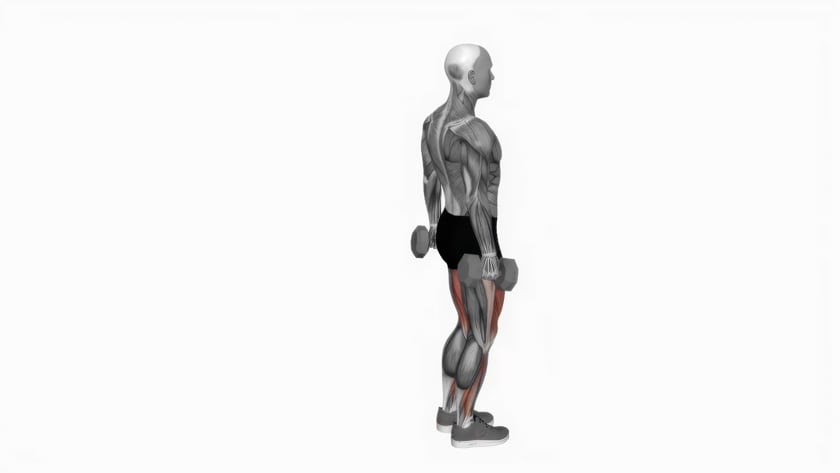
The Dumbbell Reverse Lunge is a fundamental lower-body exercise that primarily strengthens the quadriceps and glutes while also engaging the hamstrings, calves and muscles responsible for stabilizing the hips and core.
Unlike a forward lunge, the movement begins by stepping backward, lowering into a split position and then returning to the starting stance.
The video animation demonstrates the traditional dumbbell version of the Reverse Lunge. The exerciser begins standing with a dumbbell held in each hand at the sides, steps one foot backward and lowers the body by bending both knees.
The front leg provides much of the force needed to return to standing before the movement is repeated with the opposite leg.
How to Perform
Stand upright with your feet approximately hip-width apart and hold a dumbbell in each hand with your arms extended naturally alongside your body.
Keep your chest lifted, shoulders relaxed and abdominal muscles gently braced.
Shift your weight slightly onto one leg and take a controlled step backward with the opposite foot.
Place the ball of the rear foot securely on the floor and begin bending both knees.
Lower your body toward the floor while maintaining a stable torso and keeping the front foot firmly planted.
Allow the rear knee to travel toward the floor while the front knee bends naturally.
Descend only as far as you can while maintaining balance, alignment and control.
Press firmly through the front foot while extending the front knee and hip.
Step the rear foot forward and return to the upright starting position.
Repeat the movement with the opposite leg, or complete the desired repetitions on one side before switching legs.
Tips
Begin with relatively light dumbbells until you are comfortable with the stepping pattern and can maintain good balance.
Step far enough backward to create a comfortable stance that allows both knees to bend without crowding the front leg.
Keep some space between your feet from side to side rather than placing them directly behind one another. This creates a more stable base of support.
Keep your entire front foot in contact with the floor throughout the movement.
Think about lowering your body toward the floor rather than simply reaching backward with the rear leg.
Maintain a long, controlled spinal position. A small amount of natural forward torso inclination can occur, but avoid rounding the back.
Keep the front knee tracking generally in the same direction as the toes and avoid allowing it to collapse inward.
Control the backward step and descent rather than dropping rapidly into the lunge.
Use the front leg to drive yourself back to standing rather than relying primarily on a push from the rear foot.
If balance is difficult, practice the Reverse Lunge using only your body weight before adding dumbbells.
Benefits
The Dumbbell Reverse Lunge strengthens the major muscles of the lower body, particularly the quadriceps and glutes, while the hamstrings and other lower-body muscles assist with movement and stabilization.
Because one leg is emphasized at a time, the exercise introduces unilateral lower-body training and requires greater balance and stabilization than many bilateral exercises.
Stepping backward provides a useful alternative to the forward lunge and teaches the exerciser to control the body while moving into and out of a staggered stance.
The exercise also develops coordination between the hips, knees and ankles while requiring the trunk to remain stable as the legs move.
Dumbbells make the exercise easy to progress. Once the movement can be performed comfortably with body weight, resistance can gradually be increased.
The Dumbbell Reverse Lunge complements bilateral exercises such as squats and leg presses by adding a single-leg emphasis to a balanced lower-body program.
Common Mistakes
Taking too short a step backward can create an awkward stance and make it difficult to lower the body comfortably.
Stepping directly behind the front foot creates a narrow base of support and can make balance unnecessarily difficult.
Allowing the front knee to collapse inward reduces lower-body alignment and control.
Letting the front heel rise from the floor reduces stability and can change how force is distributed through the front leg.
Leaning excessively forward or rounding the back reduces postural control.
Dropping rapidly toward the floor rather than controlling the lowering phase can make the exercise harder to stabilize.
Pushing primarily off the rear foot to return to standing reduces the emphasis on the front leg.
Taking an excessively long backward step can make it difficult to maintain balance and return smoothly to the starting position.
Using dumbbells that are too heavy can interfere with balance, range of motion and proper movement technique.
Rushing the transition from one leg to the other can turn the exercise into a momentum-driven movement rather than a controlled strength exercise.
FAQ
Safety Note
Use an open, stable exercise area with enough space to step backward safely.
Begin with body weight or light dumbbells until you are comfortable with the movement and can maintain your balance.
Keep the front foot firmly planted and maintain control of the front knee throughout the exercise.
Avoid allowing the front knee to collapse inward during either the lowering or rising phase.
Maintain a controlled torso position and avoid excessive rounding of the back.
Step backward under control and make sure the rear foot is securely positioned before lowering your body.
Use a comfortable range of motion and do not force the rear knee toward the floor.
Increase dumbbell resistance gradually as strength, coordination and balance improve.
Stop the exercise if you experience sharp, persistent or unusual pain in your knees, hips, ankles or lower back.
If you have an existing spinal injury or chronic back pain, consult your physician or another qualified healthcare professional before performing this or any other exercise.