
Static Split Squat (Dumbbells)
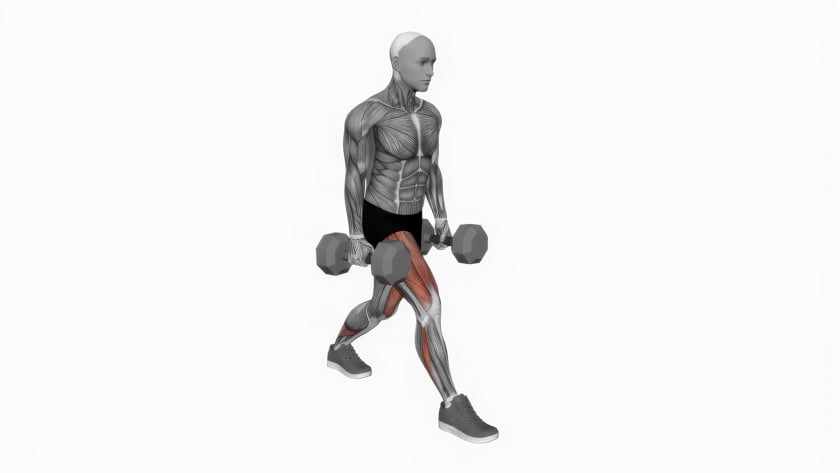
The Static Split Squat is a fundamental lower-body exercise that primarily strengthens the quadriceps and glutes while also involving the hamstrings, calves, hip stabilizers and core.
Unlike a forward or reverse lunge, the feet remain in a staggered position throughout the set. The body lowers and rises vertically rather than repeatedly stepping forward or backward.
The video animation demonstrates the dumbbell version of a traditional Static Split Squat. The exerciser holds a dumbbell in each hand with the arms extended alongside the body. One foot is positioned forward and the other behind in a staggered stance. Both knees bend as the body lowers toward the floor, then the exerciser presses through the legs to return to the starting position.
Importantly, the rear foot remains on the floor rather than being elevated on a bench, distinguishing this exercise from a Bulgarian or rear-foot-elevated split squat.
How to Perform
Stand upright while holding a dumbbell in each hand with your arms comfortably extended alongside your body.
Step one foot forward and the other foot backward into a comfortable staggered stance.
Keep your feet approximately hip-width apart from side to side rather than positioning them directly on one line.
Place the heel of the rear foot off the floor so the back foot is supported primarily by the ball of the foot.
Keep your chest lifted, gently brace your abdominal muscles and maintain a neutral spinal position.
Bend both knees and lower your body toward the floor under control.
Allow the rear knee to travel downward toward the floor while the front knee bends naturally.
Lower only as far as you can while maintaining balance, alignment and control.
Press through the front foot and extend your knees and hips to raise your body back to the starting position.
Maintain the staggered stance throughout the set rather than stepping forward or backward between repetitions.
Complete the desired repetitions, then switch your lead leg and repeat on the opposite side.
Tips
Start with a sufficiently long stance that allows you to lower your body comfortably without feeling crowded between your feet.
Keep some space between your feet from side to side. A very narrow, tightrope-like stance makes balancing unnecessarily difficult.
Think about lowering your body straight down rather than moving forward toward your front foot.
Keep your front foot firmly planted throughout the movement.
Maintain control of the front knee and keep it generally aligned with the direction of your toes. Inward knee collapse is a common error during split-squat variations.
Keep your torso tall and your abdominal muscles gently engaged.
Allow your rear heel to remain elevated while the ball of the rear foot stays securely in contact with the floor.
Use relatively light dumbbells while learning the movement. Balance and positioning are more important than the amount of resistance.
Perform the repetitions slowly enough to maintain control during both the lowering and rising phases.
If balance is initially difficult, learn the movement without dumbbells before adding external resistance.
Benefits
The Static Split Squat strengthens the quadriceps and glutes while also involving the hamstrings and muscles responsible for stabilizing the hips, trunk and ankles.
The staggered stance allows each leg to be trained with greater individual emphasis than during a traditional bilateral squat.
Because the feet remain stationary, the Static Split Squat introduces unilateral lower-body training without requiring the stepping and repositioning involved in a traditional lunge.
The exercise challenges balance and lower-body stability while still using a relatively simple and recognizable movement pattern.
Holding dumbbells alongside the body provides a straightforward way to progressively increase resistance as strength and coordination improve.
The Static Split Squat also provides a useful foundation for progressing to exercises such as reverse lunges and more advanced rear-foot-elevated split squats.
Common Mistakes
Positioning the feet directly behind one another creates an unnecessarily narrow base of support and can make balance difficult.
Taking a stance that is too short can make it difficult to lower the body comfortably while maintaining good alignment.
Allowing the front knee to collapse inward is a common error.
Leaning excessively forward shifts the torso away from a controlled upright position.
Pushing predominantly through the rear foot can reduce the intended contribution of the front leg.
Allowing the front heel to rise from the floor reduces stability.
Using dumbbells that are too heavy can cause loss of balance, shortened range of motion or poor knee and torso positioning.
Dropping rapidly into the bottom position reduces muscular control and may make balance more difficult.
Trying to force the rear knee all the way to the floor is unnecessary. Range of motion should be determined by mobility, comfort and the ability to maintain good positioning.
Turning the exercise into a lunge by stepping forward and backward between repetitions changes the movement demonstrated in the video. In the Static Split Squat, both feet remain planted in the staggered stance throughout the set.
FAQ
Safety Note
Choose a stable exercise area with enough room to establish a comfortable staggered stance.
Begin with body weight or light dumbbells until you can maintain good balance and movement control.
Keep your front foot firmly planted and maintain control of the front knee throughout the exercise.
Avoid allowing the front knee to collapse inward as you lower or rise.
Maintain a controlled torso position and avoid excessive forward leaning or rounding of the back.
Lower yourself only through a range of motion that allows you to maintain balance and comfortable knee and hip positioning.
Do not force the rear knee to touch the floor.
If necessary, practice the movement without dumbbells before adding external resistance.
Stop the exercise if you experience sharp, persistent or unusual pain in your knees, hips, ankles or lower back.
If you have an existing spinal injury or chronic back pain, consult your physician or another qualified healthcare professional before performing this or any other exercise.