
Leg Curl Seated
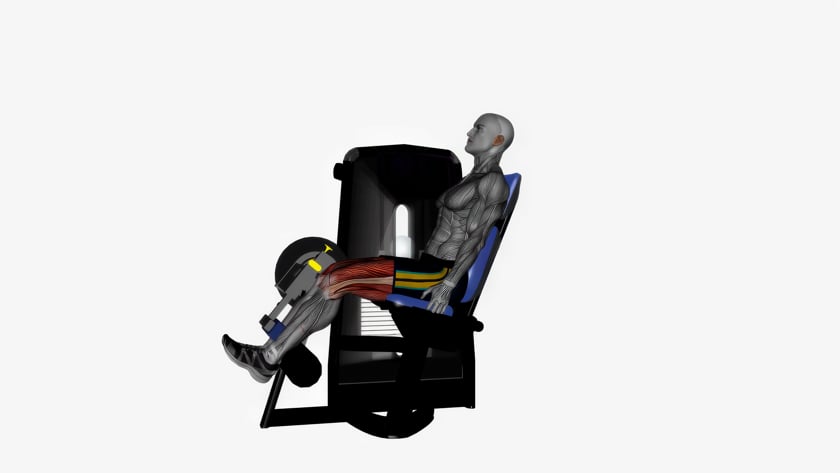
The Seated Leg Curl is a beginner-friendly machine exercise that primarily strengthens the hamstrings, the group of muscles located along the back of the thigh.
The hamstrings produce knee flexion, which is the bending movement used to pull the lower legs downward and back during the exercise.
The video animation demonstrates a bilateral Seated Leg Curl performed on a selectorized weight machine. The exerciser sits with the back supported against the pad and the legs initially extended forward.
A padded lever rests against the lower legs and a thigh restraint helps keep the upper legs securely positioned. Both knees are bent simultaneously to pull the resistance downward and back, followed by a controlled return to the starting position.
This machine setup provides considerable body support, allowing the exerciser to concentrate on bending the knees and contracting the hamstrings without the balance demands of standing lower-body exercises.
The Seated Leg Curl also complements the Dumbbell Romanian Deadlift and Cable Pull-Through already included in this Fundamental Core group. Those exercises train the hamstrings primarily through movement at the hip, while the Leg Curl trains them through knee flexion.
How to Perform
Sit on the leg curl machine with your back comfortably against the backrest.
Adjust the seat so your knees align closely with the machine's pivot or hinge point.
Position the lower-leg pad against the lower portion of your calves, near but not directly on the heels.
Adjust the thigh restraint so it rests securely above your knees and helps keep your thighs in position.
Begin with your legs extended comfortably in front of you without forcefully locking your knees.
Place your hands on the machine handles for support and gently brace your abdominal muscles.
Keep your head aligned with your spine and your torso against the backrest.
Contract your hamstrings and bend both knees, pulling the padded lever downward and back.
Continue the movement through a comfortable range while keeping your hips and torso stable.
Pause briefly at the end of the curling movement.
Slowly extend your knees and allow the resistance to return toward the starting position under control.
Repeat for the desired number of repetitions.
Position the knee near the machine hinge, keeping the abdominal muscles braced and driving the heels downward toward the glutes without arching the lower back.
Tips
Take time to properly adjust the machine before beginning. Correct alignment between your knees and the machine's pivot point helps the machine move naturally with your knee joints.
Keep your back against the backrest and your torso relatively still throughout the exercise.
Secure the thigh pad comfortably above your knees. It should help prevent your thighs from lifting as you curl the resistance.
Think about pulling your heels downward and back rather than simply moving the machine pad.
Concentrate on contracting the hamstrings as you bend your knees.
Use a smooth, controlled movement in both directions.
Slow the return of the weight rather than allowing the resistance to pull your legs rapidly back toward the starting position.
Keep your feet and knees generally aligned rather than allowing your feet to turn excessively inward or outward. Caution against turning the toes outward during the exercise.
Use a resistance that allows you to maintain your position against the seat throughout the entire repetition.
Benefits
The Seated Leg Curl directly strengthens the hamstrings through knee flexion.
Because the machine supports the torso and provides a guided movement path, the exercise allows beginners to focus on hamstring contraction without significant balance or coordination demands.
The exercise provides a simple way to progressively increase resistance as hamstring strength improves.
The seated position provides a different training stimulus from hip-hinge exercises such as Romanian Deadlifts. Since the hamstrings cross both the hip and knee joints, including both hip-extension and knee-flexion exercises provides a more comprehensive approach to hamstring training.
A comprehensive hamstring program can include both a hip-joint exercise, such as a deadlift, and a knee-joint exercise, such as a leg curl, because the two provide different but complementary training benefits.
Common Mistakes
Using too much resistance can cause the exerciser to jerk the weight or shift the torso rather than allowing the hamstrings to perform the movement.
Failing to properly adjust the seat can place the knees out of alignment with the machine's pivot point.
Allowing the thighs to lift away from the seat reduces stability and may indicate that the resistance is too heavy or the thigh restraint is not properly adjusted.
Arching the lower back during the curling movement is unnecessary and should be avoided.
Allowing the weight to return too quickly reduces control during the lengthening phase of the exercise.
Using momentum to initiate each repetition reduces the emphasis on controlled hamstring contraction.
Turning the feet excessively outward or changing foot position during the repetition can interfere with consistent technique.
Lifting the head or jutting the chin forward can disrupt neutral head and neck alignment.
FAQ
Safety Note
Adjust the machine before beginning so your knees are positioned close to the machine's pivot point and the lower-leg pad rests comfortably against your lower calves.
Make sure the thigh restraint is secure but comfortable and does not place excessive pressure on your legs.
Begin with a light resistance until you are familiar with the machine and can perform the exercise smoothly.
Keep your back against the support pad and avoid excessive arching of the lower back.
Use a controlled range of motion and avoid forcefully locking the knees when returning to the starting position.
Do not use momentum or allow the weight stack to pull your legs rapidly back to the starting position.
Stop the exercise if you experience sharp, persistent or unusual pain in your knees, hamstrings, hips or lower back.
If you have an existing spinal injury or chronic back pain, consult your physician or another qualified healthcare professional before performing this or any other exercise.