
Cable Pull-Through
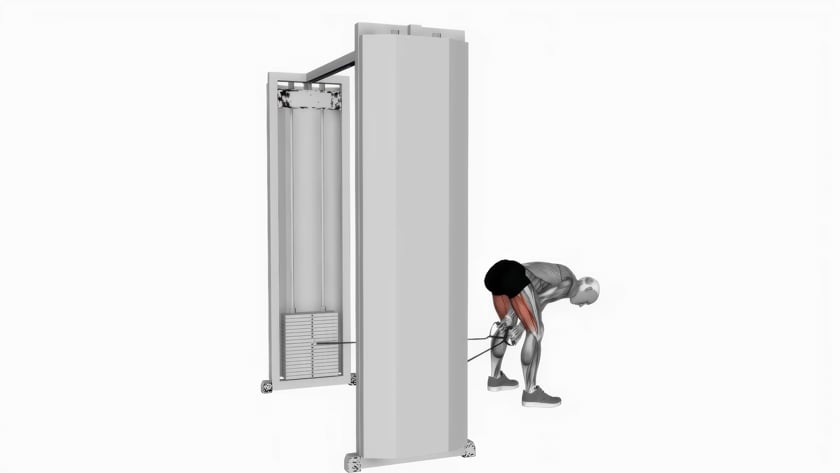
The Cable Pull-Through is a lower-body hip-hinge exercise that primarily targets the glutes and hamstrings while requiring the muscles of the core and back to stabilize the torso.
The movement uses a low cable and rope attachment to provide resistance as the hips move backward and then extend forward. This makes the exercise a useful cable-based alternative for developing the same fundamental hip-hinge pattern used in Romanian deadlifts and other posterior-chain exercises.
The video animation demonstrates the exercise with the exerciser facing away from a low cable pulley and holding a rope attachment between the legs. The exerciser takes a stable stance in front of the cable, maintains a slight bend in the knees and pushes the hips backward toward the cable machine.
The rope travels backward between the legs as the torso inclines forward. The exerciser then drives the hips forward and returns to a tall standing position.
The key movement demonstrated in the video is a hip hinge rather than a squat. The hips travel backward while knee movement remains relatively limited. We emphasize this basic hip-hinge mechanic: push the hips backward while maintaining a neutral spine and slight knee bend, then contract the glutes and extend the hips to return to standing.
How to Perform
Attach a rope handle to the lowest setting of a cable machine.
Stand facing away from the cable machine with the rope extending between your legs.
Hold one end of the rope in each hand and step forward until there is tension on the cable.
Position your feet approximately hip- to shoulder-width apart with your knees slightly bent.
Stand tall, gently brace your abdominal muscles and maintain a neutral position through your head, neck and spine.
Begin the movement by pushing your hips backward toward the cable machine.
Allow your torso to incline forward naturally as your hips move back while maintaining the slight bend in your knees.
Continue hinging until you feel a comfortable stretch through your hamstrings while maintaining control of your spine.
Press your feet into the floor, squeeze your glutes and drive your hips forward.
Return to a tall standing position with your hips extended.
Pause briefly, then push your hips backward to begin the next repetition.
We emphasize pushing the hips backward while maintaining a neutral spine and slightly bent knees, then driving the hips forward to return to standing.
Tips
Think “hips back, hips forward.” This simple cue helps reinforce that the Cable Pull-Through is primarily a hip-hinge exercise rather than a squat.
Keep the rope centered between your legs throughout the movement.
Step far enough away from the cable machine that the weight stack remains under tension throughout the exercise.
Maintain a slight bend in your knees, but avoid repeatedly bending and straightening them as you would during a squat.
Keep your abdominal muscles engaged and maintain a neutral spine as your torso inclines forward.
Allow the hips to travel backward rather than simply lowering your upper body toward the floor.
Hinge only as far as you can while maintaining good spinal position and feeling a comfortable stretch through the hamstrings.
Drive your hips forward and contract your glutes as you return to standing.
Finish tall rather than leaning backward at the top of the movement.
Use a light resistance when first learning the exercise so you can concentrate on the hip-hinge pattern.
Benefits
The Cable Pull-Through strengthens the posterior chain, particularly the glutes and hamstrings.
The exercise reinforces the fundamental hip-hinge movement pattern.
Because the resistance comes from behind the body, the cable provides continuous resistance as the exerciser moves through hip extension.
The Cable Pull-Through can provide a useful alternative to dumbbell or barbell hinge exercises for someone learning how to move primarily through the hips.
The standing position also requires the abdominal and spinal stabilizing muscles to maintain control of the torso while the hips move.
Within a balanced lower-body program, the Cable Pull-Through complements squat and lunge exercises by providing additional emphasis on hip extension and the posterior chain.
Common Mistakes
Squatting rather than hinging is one of the most common technique errors. Excessive knee bending changes the movement pattern and reduces the emphasis on the hip hinge.
Rounding the back while the hips move backward can compromise the intended position of the exercise.
Standing too close to the cable machine may allow the cable to lose tension during part of the movement.
Allowing the arms to actively pull the rope changes the exercise. The hands and arms should primarily hold the rope while the hips generate the movement.
Lowering the torso without pushing the hips backward can shift unnecessary stress toward the lower back.
Bending the knees excessively turns the exercise into more of a squat than a hinge.
Using too much resistance can make it difficult to maintain balance and proper hip-hinge mechanics.
Moving too quickly can reduce control and make it harder to maintain proper positioning.
Hyperextending or leaning backward at the top of the movement is unnecessary. Finish tall with the glutes contracted and the spine controlled.
FAQ
Safety Note
Make sure the rope attachment is securely connected to the cable before beginning the exercise.
Use a stable stance and step far enough from the machine to maintain cable tension without allowing the weight to pull you backward.
Begin with a light resistance until you are comfortable with the movement and balance requirements.
Maintain a neutral spinal position and avoid rounding or excessively arching your lower back.
Keep the knees slightly bent and initiate the movement by pushing the hips backward.
Do not force the range of motion beyond the point where you can maintain proper hip-hinge mechanics.
Return to standing under control and avoid leaning backward or hyperextending your lower back at the top.
Stop the exercise if you experience sharp, persistent or unusual pain in your back, hips or legs.
If you have an existing spinal injury or chronic back pain, consult your physician or another qualified healthcare professional before performing this or any other exercise.