
Dumbbell Romanian Deadlift
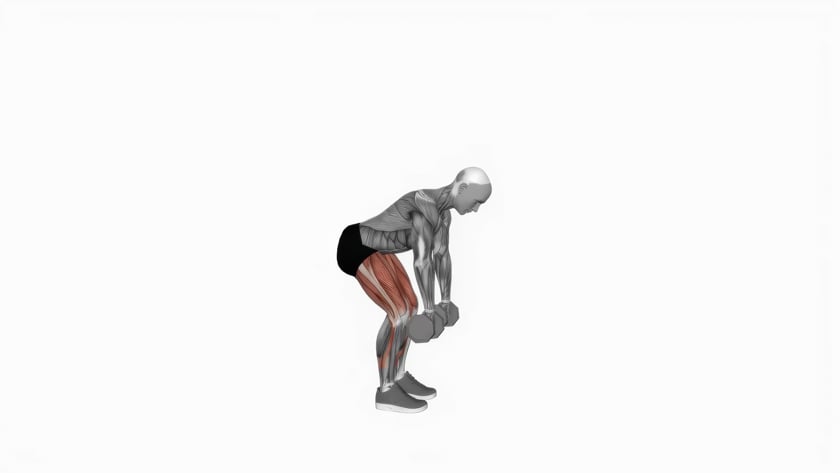
The Dumbbell Romanian Deadlift is a fundamental hip-hinge exercise that primarily strengthens the hamstrings and glutes while requiring the muscles of the trunk and back to stabilize the spine.
Unlike a traditional deadlift, the Romanian Deadlift begins from a standing position and uses relatively little knee movement, placing greater emphasis on hip flexion and extension.
The video animation demonstrates the two-dumbbell version of the Romanian Deadlift. The exerciser stands with a dumbbell in each hand, maintains a slight bend in the knees and pushes the hips backward as the dumbbells travel downward close to the legs.
The torso naturally inclines forward as the hips move back. The exerciser then drives the hips forward to return to a tall standing position.
The important distinction shown in the video is that this is a hip hinge rather than a squat. The knees remain slightly bent but relatively stationary while most of the movement occurs at the hips.
How to Perform
Stand upright with your feet approximately hip-width apart and hold a dumbbell in each hand.
Position the dumbbells in front of or slightly alongside your thighs with your arms extended.
Maintain a slight bend in your knees and gently brace your abdominal muscles.
Keep your head and spine in a neutral position and your shoulders controlled.
Begin the movement by pushing your hips backward while allowing your torso to incline forward.
Keep the dumbbells close to your thighs and legs as they travel downward.
Continue hinging until you feel a comfortable stretch through the back of your thighs. Your individual flexibility will determine how far the dumbbells travel.
Maintain the slight knee bend and neutral spinal position throughout the lowering phase.
Press your feet into the floor and drive your hips forward to return to standing.
Finish in a tall position with your hips extended and glutes contracted, without leaning backward or excessively arching your lower back.
We recommend prioritizing spinal alignment rather than trying to achieve a predetermined depth. We also recommend ending the downward phase when the appropriate bottom position is reached or when a neutral spine can no longer be maintained.
Tips
Think “hips back” rather than “bend down.” This helps establish the hip-hinge movement that distinguishes the Romanian Deadlift from a squat.
Keep the dumbbells close to your legs throughout the exercise. Allowing the weights to drift forward increases the distance between the resistance and your body and can make maintaining good positioning more difficult. We emphasize keeping the resistance close to the body during the RDL.
Maintain a slight bend in your knees, but avoid continuing to bend them as you lower. Excessive knee flexion changes the exercise toward a squat or conventional deadlift pattern.
Keep your neck aligned with the rest of your spine. Avoid lifting your head to look straight ahead as your torso approaches a more horizontal position.
Lower only as far as your hip and hamstring mobility comfortably allows while maintaining your spinal position.
Move slowly enough to feel the hamstrings lengthen during the downward phase.
Drive your hips forward as you return to standing and finish by contracting your glutes.
Begin with relatively light dumbbells while learning the hip-hinge pattern before gradually increasing resistance.
Benefits
The Dumbbell Romanian Deadlift develops the posterior chain, particularly the hamstrings and gluteal muscles.
The exercise teaches the hip-hinge movement pattern, which is an important component of many strength-training exercises and everyday lifting movements. Proper standing hip flexion and extension is one of the RDL's most important training benefits.
Using dumbbells provides an accessible way to learn and progressively load the Romanian Deadlift without immediately requiring a barbell.
The movement strengthens the hamstrings through both the lowering and lifting portions of the exercise while the glutes contribute strongly to hip extension.
The trunk and spinal stabilizers must maintain position while the hips move, making the exercise useful for developing coordinated lower-body and trunk control.
Deadlift-type movements such as hinge/pull exercises that target the glutes and hamstrings, making the RDL a useful complement to squat, lunge and bridge movements in a balanced lower-body program.
Common Mistakes
Rounding the lower or upper back during the downward phase is one of the most important errors to avoid. Maintain a neutral or elongated spinal position throughout the movement.
Bending the knees too much turns the movement into more of a squat and reduces the emphasis on the hip hinge.
Locking the knees completely straight can place unnecessary emphasis on the hamstrings and changes the exercise toward a stiff-legged deadlift.
Allowing the dumbbells to move too far away from the legs makes it more difficult to maintain an efficient lifting position.
Lowering the dumbbells farther simply to achieve greater range of motion can cause the spine to round. Depth should be determined by the ability to maintain proper positioning and a comfortable hamstring stretch.
Looking upward while hinging can pull the neck out of neutral alignment.
Using momentum or moving too quickly reduces control during the important lowering phase.
Using dumbbells that are too heavy can make it difficult to maintain proper hip-hinge mechanics and spinal position.
Leaning backward or excessively arching the lower back at the top is unnecessary. Finish tall with the hips extended and the glutes contracted.
FAQ
Safety Note
Use dumbbells that allow you to maintain proper control and spinal alignment throughout the exercise.
Keep the dumbbells close to your body and maintain a slight bend in your knees.
Do not force the dumbbells toward the floor. Your range of motion should be determined by your ability to hinge at the hips while maintaining proper spinal position.
Avoid rounding the back, excessive knee bending or using momentum to move the weights.
Learn the basic hip-hinge movement with little or no resistance before progressing to heavier dumbbells. ACE specifically recommends establishing control of the hip-hinge pattern before adding external resistance.
Stop the exercise if you experience sharp, persistent or unusual pain in your back, hips or legs.
If you have an existing spinal injury or chronic back pain, consult your physician or another qualified healthcare professional before performing this or any other exercise.