
Leg Press
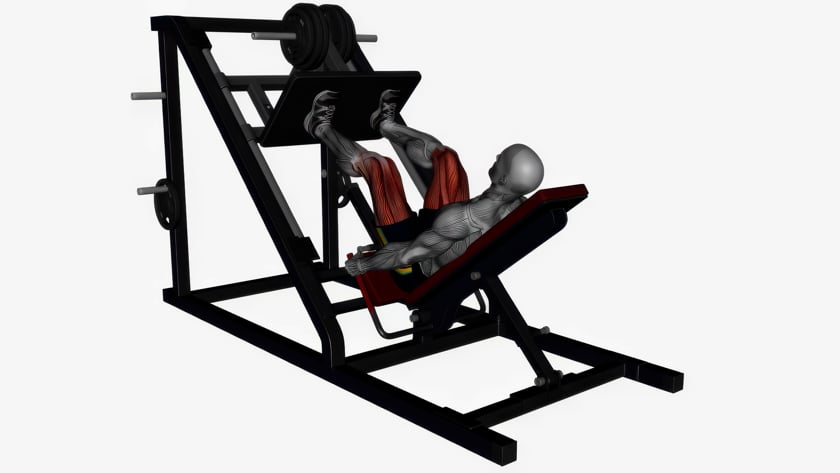
The Leg Press is a fundamental machine-based lower-body exercise that primarily strengthens the quadriceps and gluteal muscles, with assistance from the hamstrings and other muscles that stabilize the hips and legs.
The video animation demonstrates a plate-loaded angled Leg Press machine. The exerciser sits against the angled backrest with both feet positioned on the platform approximately hip- to shoulder-width apart.
From a bent-knee position, the platform is pressed away by extending the hips and knees. The platform is then lowered under control until the knees return to a comfortably bent position.
Because the machine supports the torso and guides the resistance along a fixed path, the Leg Press can be particularly useful for beginners learning to apply resistance through the legs.
It allows the exerciser to concentrate on lower-body movement without having to support an external weight with the upper body or maintain the balance required during a free-weight squat.
How to Perform
Sit securely in the Leg Press machine with your back, hips and head comfortably supported by the pads.
Place both feet flat on the platform approximately hip- to shoulder-width apart, with your toes pointing generally forward or slightly outward.
Adjust your position so that your knees begin comfortably bent and your feet remain fully supported on the platform.
Grasp the machine handles for stability and gently brace your abdominal muscles.
Release the machine's safety mechanism according to the manufacturer's instructions.
Press through your feet and smoothly extend your hips and knees to move the platform away from your body.
Continue until your legs are extended while maintaining a slight bend in the knees. Do not forcefully lock the knees.
Pause briefly, then slowly bend your hips and knees to lower the platform toward your body.
Lower only as far as you can while keeping your hips and lower back supported against the pad and maintaining control of the movement.
Press the platform away again and repeat for the desired number of repetitions.
Keep your back and head against the backrest, positioning your feet approximately hip-width apart, pressing without locking the knees and returning under control.
Tips
Keep your entire foot in contact with the platform throughout the exercise.
Keep your knees tracking in the same general direction as your toes rather than allowing them to collapse inward.
Maintain your back and hips against the pads throughout the movement.
Use a controlled tempo in both directions. Do not allow the weight to drop rapidly toward you.
Avoid forcefully locking your knees at the top of the movement.
Choose a resistance that allows you to complete each repetition smoothly without changing your body position.
Do not lower the platform so far that your hips begin to roll away from the pad or your lower back rounds.
Benefits
The Leg Press primarily strengthens the quadriceps and gluteal muscles. The hamstrings, hip adductors and core stabilizers also contribute to the exercise.
The machine provides a stable environment for developing lower-body strength while reducing the balance requirements associated with standing free-weight exercises.
The Leg Press allows beginners to practice coordinated hip and knee extension against resistance while the torso remains supported.
Resistance can be increased progressively as strength and technique improve, making the exercise suitable for continued progression beyond the beginner level.
The exercise complements squat-based movements by providing another way to train the major muscles of the lower body.
Common Mistakes
Using too much weight can reduce range of motion, encourage uncontrolled movement and make it difficult to maintain proper knee and hip alignment.
Allowing the knees to collapse inward is a common error.
Locking the knees at the top of the movement can place unnecessary stress on the knee joints.
Allowing the heels to lift from the platform reduces foot stability and changes the mechanics of the exercise.
Lowering the platform too far can cause the pelvis to roll and the lower back to lose contact with the backrest.
Allowing the platform to descend too quickly reduces muscular control and may make it more difficult to maintain proper positioning.
Pushing unevenly through the feet can cause one leg to contribute more than the other during a bilateral Leg Press.
FAQ
Safety Note
Before beginning, become familiar with the machine's safety stops, release mechanism and adjustment features.
Select a manageable resistance and make sure any weight plates are properly secured.
Keep your back and hips supported against the pads throughout the exercise.
Keep your feet firmly on the platform and your knees tracking in the same general direction as your toes.
Do not forcefully lock your knees at the top of the movement.
Do not lower the platform so far that your hips lift or your lower back rounds away from the backrest.
Return the machine to its safety position before attempting to exit.
Stop the exercise if you experience sharp, persistent or unusual pain in your knees, hips or lower back.
If you have an existing lower-body injury, spinal injury or chronic back pain, consult your physician or another qualified healthcare professional before performing this or any other exercise.