
Dumbbell Goblet Squat
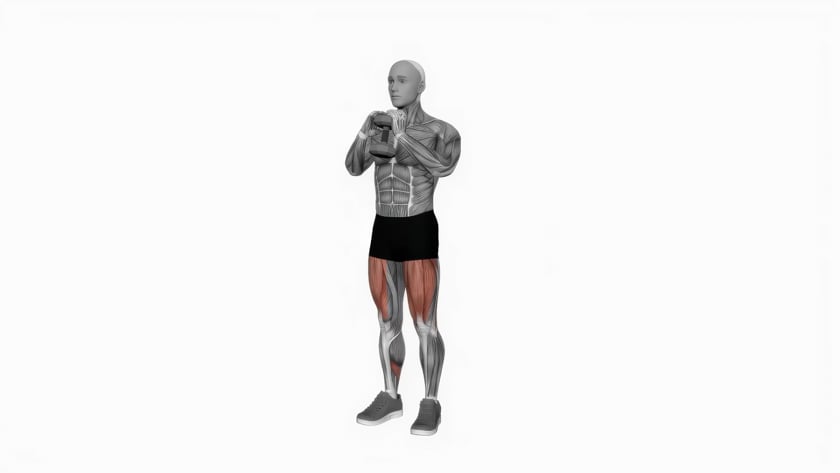
The Dumbbell Goblet Squat is a fundamental lower-body strength exercise that builds on the basic Body Weight Squat by adding resistance in front of the body.
It primarily strengthens the quadriceps and gluteal muscles while the hamstrings, inner thighs, core and upper-back muscles assist with movement and stabilization.
The video animation demonstrates the exercise with a single dumbbell held vertically in front of the chest with both hands supporting the upper end of the dumbbell. The exerciser maintains the dumbbell close to the torso throughout the movement, lowers by bending at the hips, knees and ankles, then returns to a standing position.
Holding the resistance in front of the chest provides a useful counterbalance that can help an exerciser maintain a relatively upright torso. For this reason, the goblet squat is commonly used as a progression from an unloaded squat before advancing to more complex or heavily loaded squat variations.
How to Perform
Stand upright with your feet approximately hip- to shoulder-width apart and your toes pointing generally forward or slightly outward.
Hold one dumbbell vertically in front of your chest with both hands securely supporting the upper end of the dumbbell. Keep the weight close to your body throughout the exercise.
Gently brace your abdominal muscles, keep your chest up and maintain a neutral spine.
Begin the squat by bending your hips and knees together as you lower your body toward the floor.
Keep your feet firmly planted and allow your knees to track in the same general direction as your toes.
Continue lowering as far as you can comfortably go while maintaining an upright, controlled posture and keeping the dumbbell close to your chest.
Pause briefly at the bottom of the movement.
Press your feet into the floor and extend your hips and knees to return to the standing position.
Finish upright with your hips and knees extended, then repeat for the desired number of repetitions.
Descend only as far as you can maintain a neutral spine and good movement control.
Tips
Keep the dumbbell close to your chest throughout the entire exercise. Allowing the weight to drift forward increases the demand on the arms and can encourage the torso to lean forward.
Start with a light dumbbell while learning the movement. The goal is to establish good squat mechanics before increasing resistance.
Keep your entire foot in contact with the floor rather than shifting onto your toes or allowing your heels to rise.
Keep your knees tracking in the same general direction as your toes and avoid allowing them to collapse inward.
Keep your chest up and your abdominal muscles gently braced throughout the movement.
Squat only as deeply as you can while maintaining stable feet, good knee alignment and a neutral spine. Individual mobility and body proportions affect comfortable squat depth.
Move slowly and deliberately rather than dropping quickly into the bottom position.
Benefits
The Dumbbell Goblet Squat strengthens the quadriceps and gluteal muscles while also recruiting the hamstrings, adductors and core stabilizers. The upper-back musculature also helps maintain the front-loaded dumbbell position.
The exercise reinforces the fundamental squat movement pattern while adding manageable external resistance.
Holding the dumbbell in front of the body provides a counterbalance that can make it easier for many beginners to maintain an upright torso and controlled squat position.
The goblet squat provides a logical progression between the Body Weight Squat and more advanced loaded squat variations.
Because the exercise requires only a single dumbbell, it is practical for fitness studios, home exercise environments and other settings with limited equipment.
Common Mistakes
Holding the dumbbell too far away from the chest can pull the upper body forward and make it more difficult to maintain good posture.
Using too much weight before mastering the squat pattern can lead to compensations and reduced movement control.
Allowing the knees to collapse inward is a common squat fault.
Allowing the heels to rise or the feet to excessively flatten or rotate can indicate that the exerciser has moved beyond a range that can currently be controlled.
Excessively leaning forward or allowing the chest to drop changes the squat position and may indicate that the weight is too heavy or the squat is too deep. Forward lean is a common squat compensation.
Rounding or excessively arching the lower back reduces control of the torso during the exercise.
Dropping quickly into the bottom position or bouncing to begin the upward movement reduces muscular control.
Forcing excessive depth can cause the knees, feet or spine to move out of good alignment. Appropriate squat depth should be based on the individual's mobility and ability to maintain proper form.
FAQ
Safety Note
Use a dumbbell that you can hold securely and control throughout the entire exercise.
Keep the dumbbell close to your chest and maintain a stable grip with both hands.
Keep your feet firmly planted and maintain control of your knees, hips and torso throughout each repetition.
Do not force yourself into a deeper squat if doing so causes your heels to rise, your knees to collapse inward or your lower back to round.
Increase resistance gradually only after you can perform the exercise consistently with proper form.
Stop the exercise if you experience sharp, persistent or unusual pain in your knees, hips, ankles or lower back.
If you have an existing lower-body injury, spinal injury or chronic back pain, consult your physician or another qualified healthcare professional before performing this or any other exercise.