
Body Weight Squat
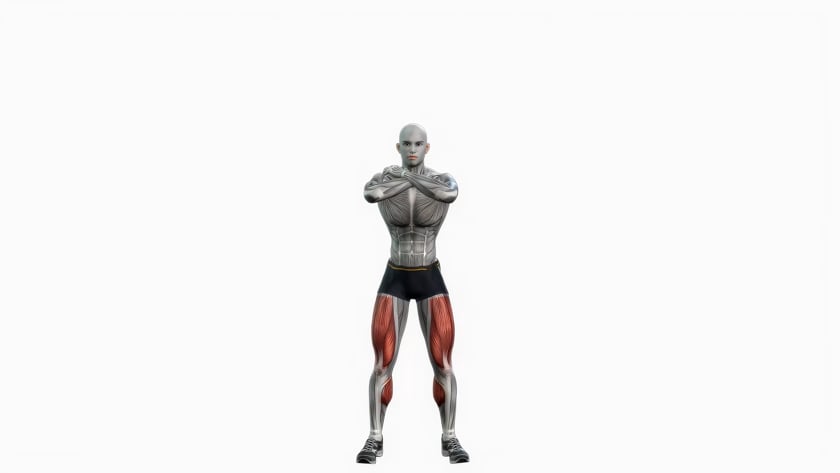
The Body Weight Squat is one of the most fundamental lower-body exercises and an important movement pattern for beginning exercisers.
It strengthens the quadriceps and gluteal muscles while also involving the hamstrings, calves and core musculature to help control the hips, knees, ankles and torso.
The video animation demonstrates a traditional body weight squat performed with the feet approximately shoulder-width apart and the arms crossed in front of the upper chest. From the standing position, the hips and knees bend together as the body lowers into the squat. The exerciser then extends the hips and knees to return to an upright position.
The body-mass squat is a fundamental movement competency that should be developed before progressing to more technically demanding resistance exercises.
How to Perform
Stand upright with your feet approximately shoulder-width apart. Position your feet comfortably with your toes pointing generally forward or slightly outward.
Cross your arms in front of your chest as demonstrated in the video.
Gently brace your abdominal muscles and maintain a neutral spine with your chest up and your head facing forward.
Begin the squat by allowing your hips to move back and down while simultaneously bending your knees.
Keep your feet firmly planted on the floor and allow your knees to track in the same general direction as your toes.
Continue lowering your body as far as you can comfortably go while maintaining good posture, stable feet and controlled knee alignment. Squat depth will vary according to individual mobility, strength and control.
Pause briefly at the bottom of the movement.
Press your feet into the floor and extend your knees and hips to return to the standing position.
Finish tall with your hips and knees extended without forcefully locking the knees or pushing the hips excessively forward.
Tips
Keep your entire foot in contact with the floor throughout the exercise rather than allowing your heels to rise.
Keep your knees tracking in the same direction as your toes. Avoid allowing the knees to collapse inward.
Maintain a controlled tempo rather than dropping quickly into the bottom of the squat.
Keep your chest up and maintain a relatively neutral spine throughout the movement.
Think about sitting your hips back and down while bending the knees rather than simply bending forward at the waist.
Do not force yourself to reach a predetermined depth. Squat only to a depth that can be controlled without significant movement compensations.
Breathe naturally. Inhale as you lower and exhale as you return to standing.
Benefits
The Body Weight Squat strengthens the quadriceps and gluteal muscles while also involving the hamstrings, calves and core stabilizers.
Squatting trains coordinated movement of the hips, knees and ankles and reinforces a movement pattern used in many everyday activities, including sitting down and standing up.
Because no external resistance is required, beginners can concentrate on learning movement control and proper positioning before progressing to weighted squat variations.
The squat is an effective exercise for improving lower-body muscular endurance, strength and power. We recommend the bodyweight squat as an early step in a systematic squat progression.
Squatting and general bodyweight control is a foundational movement that help prepare beginners for more advanced resistance-training movements.
Common Mistakes
Allowing the knees to collapse inward is a common squat compensation. Keep the knees tracking in line with the feet throughout both the lowering and rising portions of the exercise.
Allowing the heels to lift from the floor may indicate that the squat is being performed beyond the exerciser's current comfortable range or that ankle mobility is limiting the movement.
Excessively leaning the torso forward can shift the movement away from a well-controlled squat pattern.
Rounding or excessively arching the lower back reduces spinal control during the movement.
Dropping too quickly into the squat can make it more difficult to maintain proper knee, hip and torso alignment.
Forcing excessive depth can cause compensations such as heel lift, knee collapse or spinal rounding. Squat only as deeply as you can while maintaining good technique.
Pushing the knees excessively outward or trying to prevent them from moving forward at all can also distort the natural squat pattern. Individual anatomy and mobility affect knee position during a properly performed squat.
FAQ
Safety Note
Perform the Body Weight Squat slowly and within a comfortable range of motion.
Keep your feet firmly planted and maintain control of your knees, hips and torso throughout each repetition.
Do not force yourself into a deeper squat if doing so causes your heels to lift, your knees to collapse inward or your lower back to round excessively.
Use a stable support or reduce the squat depth if balance is difficult to maintain.
Stop the exercise if you experience sharp, persistent or unusual pain in your knees, hips, ankles or lower back.
If you have an existing lower-body injury, spinal injury or chronic back pain, consult your physician or another qualified healthcare professional before performing this or any other exercise.