
Resistance Band Face Pull
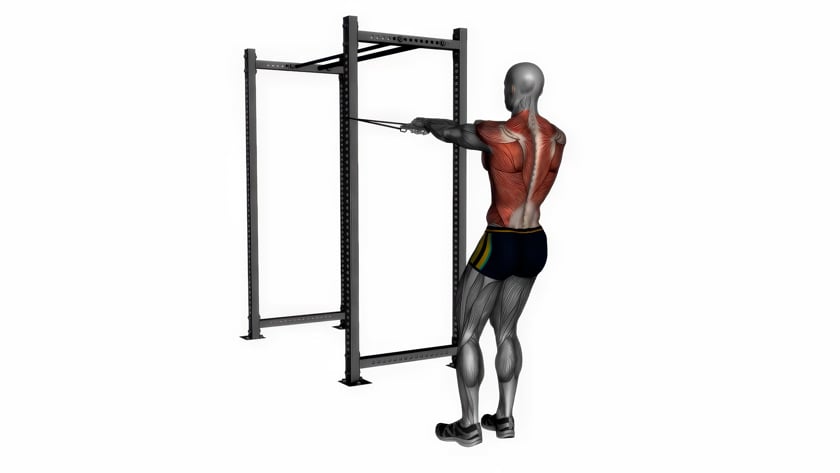
The Resistance Band Face Pull is a pulling exercise that strengthens the back of the shoulders and upper back while encouraging controlled movement of the shoulder blades.
The primary muscles involved include the posterior deltoids and rhomboids, with assistance from the middle trapezius, infraspinatus and biceps.
The video animation demonstrates the exercise using a resistance band anchored to a stable rack at approximately upper-chest to face height. The exerciser holds the band with both hands, begins with the arms extended and pulls the hands toward the sides of the face while the elbows travel outward and backward. The shoulder blades draw together as the band approaches the face, followed by a slow, controlled return to the starting position.
This resistance-band version follows the same fundamental movement pattern as a cable face pull while making the exercise practical for a studio, home or other setting where a cable machine is unavailable.
Face pulls can be performed with either a cable and rope attachment or a resistance band.
How to Perform
Secure a resistance band to a stable anchor at approximately upper-chest to face height.
Stand facing the anchor with your feet approximately hip- to shoulder-width apart.
Hold one end of the band in each hand and step backward until there is light tension in the band with your arms extended.
Stand tall, gently engage your abdominal muscles and keep your head and spine in a neutral position.
Begin the movement by drawing your shoulder blades back as you bend your elbows and pull your hands toward the sides of your face.
Allow the elbows to travel outward and backward as demonstrated in the video. Think about pulling the band apart as it approaches your face rather than simply pulling it toward your chest.
Finish with your hands near the sides of your face and your shoulder blades gently drawn together.
Pause briefly in the contracted position.
Slowly extend your arms and return to the starting position while maintaining control of the band.
Tips
Choose a light to moderate resistance band that allows you to complete the entire movement without straining or using momentum.
Keep your torso upright and relatively still throughout the exercise.
Think about initiating the pull through the shoulders and upper back rather than simply bending your elbows.
Draw the shoulder blades together as you pull, but avoid aggressively squeezing or forcing them into an uncomfortable position.
Keep your shoulders down rather than shrugging them toward your ears.
Pull toward the face rather than toward the waist or abdomen.
Keep tension on the band and return slowly instead of allowing the band to snap your arms forward.
Use only as much resistance as you can control with good technique.
Benefits
The Resistance Band Face Pull strengthens the posterior deltoids, which help move and control the upper arm at the shoulder.
The exercise also recruits the rhomboids and middle trapezius, which contribute to scapular retraction and control. The infraspinatus, one of the rotator-cuff muscles, also assists during the movement.
Face pulls provide a useful pulling counterpart to the shoulder presses and front-shoulder exercises commonly included in resistance-training programs.
The exercise encourages coordinated movement of the shoulder and scapular musculature.
Resistance bands make the exercise easy to incorporate into a basic training environment and allow the resistance to be adjusted by changing bands or altering the distance from the anchor.
Common Mistakes
Using a band that provides too much resistance can cause the exerciser to shorten the movement, shrug the shoulders or use momentum.
Pulling primarily with the hands and arms rather than engaging the posterior shoulders and upper back reduces the emphasis on the intended muscles.
Pulling the band toward the chest instead of toward the face changes the movement into more of a conventional rowing exercise.
Allowing the shoulders to shrug toward the ears creates unnecessary upper-trapezius involvement.
Leaning or rocking the torso backward to complete the repetition uses momentum rather than controlled muscular effort.
Allowing the band to pull the arms rapidly forward during the return reduces control of the exercise.
Flaring the rib cage or excessively arching the lower back can occur when the resistance is too strong or the exerciser is trying to create additional range of motion.
FAQ
Safety Note
Always attach the resistance band to a secure, stable anchor before beginning the exercise.
Inspect the band before each use for cracks, tears or other signs of deterioration that could cause it to break during the exercise.
Select a resistance level that allows you to maintain control throughout the entire movement.
Keep the movement smooth and controlled and avoid jerking the band or allowing it to snap back toward the anchor.
Do not force your shoulders or arms into an uncomfortable range of motion.
Stop the exercise if you experience sharp, pinching or persistent pain in the shoulder, neck or upper back.
If you have an existing shoulder injury or chronic shoulder pain, consult your physician or another qualified healthcare professional before performing this or any other exercise.