
Dumbbell External Rotation
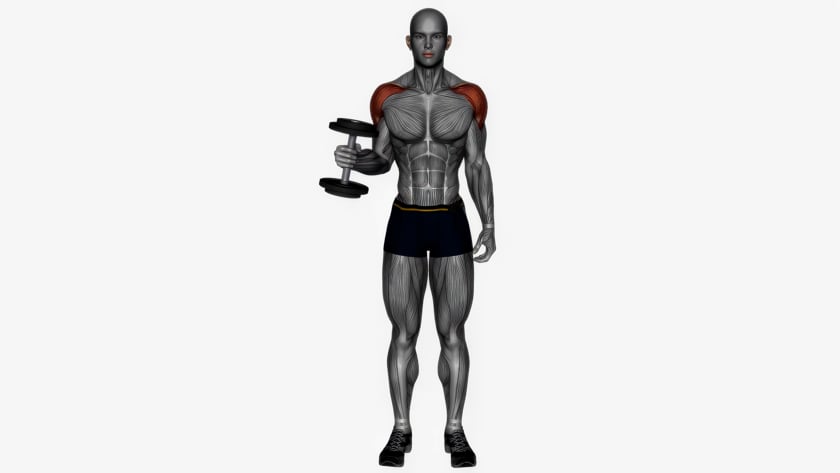
The Dumbbell External Rotation is a shoulder-strengthening exercise that emphasizes the smaller muscles responsible for externally rotating and stabilizing the shoulder joint.
In particular, external rotation recruits the infraspinatus and teres minor, two important muscles of the rotator cuff. The rotator cuff helps provide dynamic stability to the shoulder while the arm moves.
The video animation demonstrates a standing, single-arm Dumbbell External Rotation. The elbow remains bent approximately 90 degrees and positioned close to the side of the torso while the forearm rotates outward, moving the dumbbell away from the body. The upper arm should remain relatively stationary so that the movement occurs primarily through rotation at the shoulder.
Because a dumbbell is used rather than a cable or resistance band, gravity provides the resistance. This makes the movement somewhat different from the commonly demonstrated standing cable or band external rotation.
The exercise should therefore be performed with very light resistance and deliberate control, rather than treated as a heavy shoulder exercise.
How to Perform
Stand upright with your feet approximately hip- to shoulder-width apart and hold a light dumbbell in one hand.
Bend the working elbow approximately 90 degrees and keep the upper arm close to your side.
Maintain an upright posture with your abdominal muscles gently engaged and your shoulders relaxed.
Begin with the forearm positioned across the front of your body as demonstrated in the video.
Keeping the elbow bent and the upper arm relatively stationary, slowly rotate your forearm outward.
Continue rotating only as far as you can comfortably move without allowing your elbow to drift away from your side or your torso to rotate.
Pause briefly at the end of the comfortable range of motion.
Slowly rotate the forearm back toward the starting position while maintaining control of the dumbbell.
Complete the desired number of repetitions before switching arms.
We emphasize maintaining approximately 90 degrees of elbow flexion, keeping the elbow close to the body and controlling the rotation rather than allowing other parts of the body to create the movement.
Tips
Use a very light dumbbell. The rotator-cuff muscles involved in external rotation are relatively small and this exercise is intended for controlled shoulder movement rather than lifting heavy resistance.
Keep your elbow close to your torso throughout the exercise.
Think about rotating from the shoulder rather than simply moving the dumbbell with your hand.
Keep your wrist neutral rather than bending it backward or forward.
Maintain an upright torso and avoid twisting your body to increase the range of motion.
Move slowly in both directions. We recommend a controlled return during external-rotation exercises rather than allowing the resistance to pull the arm rapidly back toward the starting position.
Stop the outward rotation when you reach your natural comfortable range. More range is not necessarily better.
Benefits
The Dumbbell External Rotation specifically trains shoulder external rotation, a movement that may receive relatively little direct attention during conventional pressing and raising exercises.
The exercise strengthens the infraspinatus and teres minor, important components of the rotator cuff responsible for external rotation and dynamic stabilization of the glenohumeral joint.
Direct rotator-cuff training can complement larger shoulder exercises such as shoulder presses, lateral raises and rows by addressing the smaller stabilizing musculature of the shoulder.
The exercise requires only a light dumbbell, making it easy to incorporate into a general shoulder-strengthening program.
Common Mistakes
Using too much weight is one of the most common problems. Excessive resistance can encourage compensation from larger muscles and make it difficult to isolate the external-rotation movement.
Allowing the elbow to move away from the torso changes the mechanics of the exercise and introduces additional shoulder movement.
Twisting the torso to move the dumbbell farther outward uses momentum rather than maintaining controlled shoulder rotation.
Shrugging the shoulder toward the ear creates unnecessary tension through the neck and upper trapezius.
Moving too quickly reduces control and may make it difficult to maintain proper shoulder and elbow position.
Bending or rotating the wrist instead of maintaining a neutral wrist position shifts movement away from the intended shoulder rotation.
Forcing the arm beyond a comfortable range of motion may place unnecessary stress on the shoulder joint.
FAQ
Safety Note
Use a very light dumbbell and perform each repetition slowly and under control.
Keep the elbow close to the torso and avoid using momentum or twisting your body to increase the range of motion.
Do not force the shoulder beyond its comfortable range of external rotation.
Stop the exercise if you experience sharp, pinching or persistent shoulder pain.
Individuals with a current or previous shoulder injury, shoulder instability or significant limitation in shoulder range of motion should seek appropriate professional guidance before performing resisted external-rotation exercises.
If you have an existing shoulder injury or chronic shoulder pain, consult your physician or another qualified healthcare professional before performing this or any other exercise.