
Dumbbell Front Raise
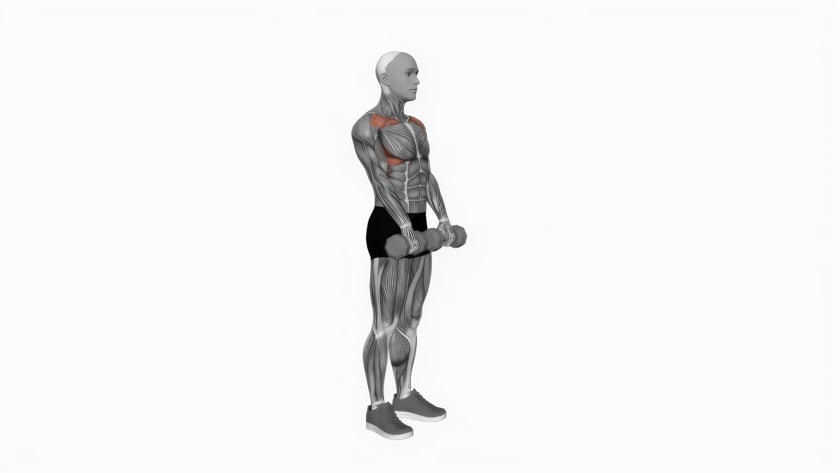
The Dumbbell Front Raise is a basic shoulder exercise that primarily targets the anterior, or front, portion of the deltoid. The movement involves shoulder flexion — raising the arms forward from the sides of the body to approximately shoulder height.
The video animation demonstrates the standard two-arm standing version of the exercise. The exerciser begins with a dumbbell in each hand near the front of the thighs, then raises both dumbbells forward simultaneously until the arms are approximately parallel with the floor before lowering them under control.
Because the anterior deltoids are also involved in shoulder-pressing exercises, the Front Raise should be viewed as a simple isolation exercise rather than the primary strength movement for the shoulders.
How to Perform
Stand upright with your feet approximately hip-width apart and hold a dumbbell in each hand in front of your thighs.
Keep your knees comfortably relaxed and brace your abdominal muscles to help stabilize your torso.
Position your shoulders down and back and maintain a neutral head and spine position.
Begin with your arms extended while maintaining a slight, comfortable bend in your elbows.
Keeping your torso still, slowly raise both dumbbells forward and upward.
Continue raising the dumbbells until your arms reach approximately shoulder height and are roughly parallel with the floor.
Pause briefly at the top while maintaining control of the weights.
Slowly lower the dumbbells back toward the front of your thighs.
Maintain the same body position throughout the movement and repeat for the desired number of repetitions.
Maintain a constant body position, raising the dumbbells directly in front to shoulder level and lowering them slowly to the starting position.
Tips
Choose relatively light dumbbells that allow you to perform the exercise without swinging or leaning backward.
Keep your abdominal muscles engaged throughout the exercise. This helps prevent the lower back from arching as the weights are raised.
Move the dumbbells smoothly rather than using momentum to initiate the lift. T
Raise the dumbbells only to approximately shoulder height. Lifting significantly higher is unnecessary for this fundamental version.
Keep your wrists neutral and avoid bending them as you raise the weights.
Maintain a slight bend in the elbows rather than forcefully locking the arms straight.
Keep your shoulders comfortably down rather than shrugging them toward your ears.
For exercisers who experience discomfort with a palms-down position, a more neutral hand position may be appropriate. Note: a pronated position creates more internal rotation at the shoulder. In that case a neutral hand position may provide a more comfortable alternative for some exercisers.
Benefits
The Dumbbell Front Raise directly trains the anterior deltoids, which contribute to raising the arms forward in front of the body.
The movement is straightforward and requires only a pair of dumbbells, making it easy to incorporate into basic resistance-training programs.
Performing the exercise with two dumbbells allows each arm to work independently while both shoulders move simultaneously.
The standing position requires the abdominal and postural muscles to stabilize the torso while the shoulders move the resistance.
The Front Raise provides a simple isolation movement that can complement compound shoulder exercises such as the Dumbbell Shoulder Press. However, balanced shoulder programming should also include exercises for the lateral and posterior portions of the deltoid rather than concentrating exclusively on the front of the shoulder.
Common Mistakes
Using dumbbells that are too heavy often causes the exerciser to swing the weights or lean backward instead of allowing the shoulders to perform the movement.
Rocking the torso forward and backward creates momentum and reduces the effectiveness of the exercise.
Arching the lower back as the dumbbells rise usually indicates that the resistance is too heavy or that the core is not adequately stabilized.
Raising the dumbbells substantially above shoulder height adds unnecessary movement for this fundamental version of the exercise.
Shrugging the shoulders upward shifts more emphasis toward the upper trapezius rather than maintaining the intended shoulder movement.
Dropping the dumbbells quickly from the top position reduces muscular control during the lowering portion of the exercise.
Excessively locking the elbows or allowing the elbows to repeatedly bend and straighten changes the movement pattern. Maintain a comfortable and relatively consistent arm position throughout each repetition.
FAQ
Safety Note
Use a manageable resistance and perform each repetition slowly and under control.
Keep your abdominal muscles engaged and maintain an upright torso. Do not compensate for heavy resistance by leaning backward or excessively arching your lower back.
Raise the dumbbells only through a comfortable range of motion and do not force the shoulders beyond approximately shoulder height for this fundamental version.
If a palms-down grip causes pinching or discomfort in the shoulder, stop the exercise. ACE notes that the internally rotated position associated with a traditional pronated Front Raise can reduce space within the shoulder joint, and a more neutral hand position may be preferable for some exercisers.
Stop the exercise if you experience sharp, pinching or persistent shoulder pain.
If you have an existing shoulder injury, significant shoulder mobility limitation or chronic shoulder pain, consult your physician or another qualified healthcare professional before performing this or any other exercise.