
Standing Dumbbell Shoulder Press
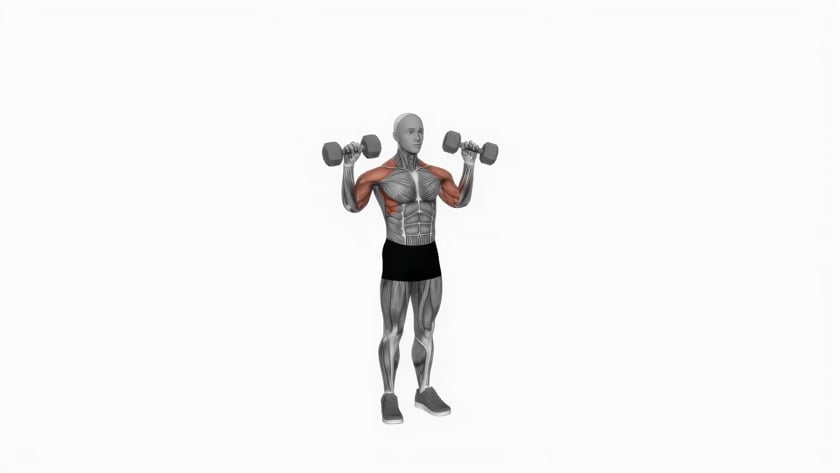
The Standing Dumbbell Shoulder Press is a fundamental upper-body exercise that strengthens the shoulders by pressing two dumbbells from approximately shoulder height to an overhead position.
Performing the exercise while standing also requires the abdominal, back and lower-body muscles to help stabilize the body as the weights move overhead.
This exercise primarily targets the deltoids while the triceps assist with extending the elbows. The uploaded video demonstrates a controlled bilateral press with both dumbbells moving together. Keep the torso upright and avoid leaning backward to help lift the weights.
How to Perform
Stand with your feet approximately hip- to shoulder-width apart and hold a dumbbell in each hand at shoulder level. Keep your knees slightly bent, chest comfortably lifted and abdominal muscles engaged.
Position the dumbbells beside your shoulders with your wrists straight and elbows bent. Keep your head in a neutral position and maintain a stable, upright torso.
Exhale as you press both dumbbells upward in a smooth, controlled motion until your arms are extended overhead. Avoid excessively arching your lower back or using your legs to drive the weights upward.
Inhale as you slowly lower the dumbbells back toward shoulder level. Maintain control throughout the descent and repeat for the desired number of repetitions. We emphasize starting with light dumbbells, developing shoulder stability and controlling both the upward and downward phases.
Tips
Brace your abdominal muscles before beginning each repetition to help keep your torso stable.
Keep your wrists aligned with your forearms rather than allowing them to bend backward under the dumbbells.
Press the weights overhead without leaning backward or excessively arching your lower back.
Use a resistance that allows you to perform every repetition smoothly and under control. Beginners should establish good shoulder stability and technique before progressing to heavier weights.
Benefits
Strengthens the anterior and middle portions of the deltoids.
Strengthens the triceps as they assist with the overhead pressing movement.
Develops upper-body pressing strength that can support everyday overhead activities.
Requires the core and other postural muscles to stabilize the torso while standing.
Provides a fundamental shoulder-strength exercise that can be progressed gradually as strength and technique improve.
Common Mistakes
Arching the lower back: Avoid leaning backward as the dumbbells move overhead. Brace your abdominal muscles and maintain a stable torso.
Using too much weight: Excessive resistance can encourage poor technique, shortened range of motion and unnecessary momentum.
Using the legs to press the weights: Keep your knees stable rather than dipping and driving upward. Using deliberate leg drive changes the exercise toward a push press.
Allowing the wrists to bend backward: Keep the wrists generally aligned with the forearms throughout the press.
Lowering the weights too quickly: Control the dumbbells as they return toward shoulder level rather than allowing gravity to pull them down.
FAQ
Safety Note
Use a weight you can control throughout the entire movement and maintain a stable torso without excessive backward lean.
Do not force the dumbbells into an overhead position if your available shoulder mobility does not allow you to reach it comfortably. NASM notes that clients with postural or mobility limitations may have difficulty maintaining proper form during overhead pressing.
Stop the exercise if you experience sharp or persistent pain in the shoulders, neck or back.
If you have an existing shoulder injury, significant shoulder mobility limitation or chronic shoulder pain, consult your physician or another qualified healthcare professional before performing this or any other exercise. ACE likewise cautions that people with current shoulder issues may need to avoid overhead presses.