
Smith Machine Press – Incline
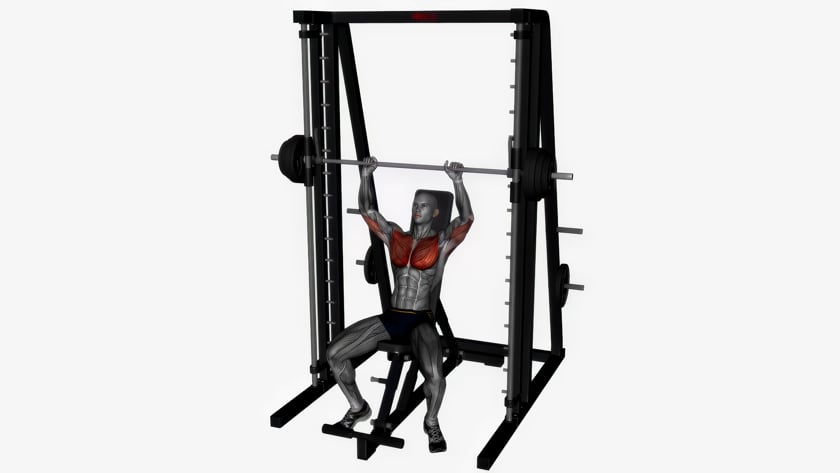
The Smith Machine Press – Incline is a fundamental upper-body pressing exercise that primarily targets the upper, or clavicular, portion of the pectoralis major while also involving the triceps and anterior deltoids. The inclined bench changes the pressing angle compared with a flat chest press, placing greater emphasis on the upper chest. NASM identifies the pectoralis major, particularly the clavicular head, and triceps as primary muscles during incline pressing, with the anterior deltoid and other shoulder muscles assisting.
As demonstrated in the uploaded video, the exercise is performed on an incline bench positioned beneath the Smith machine. The bar is lowered toward the upper chest and then pressed upward along the machine's guided track.
The Smith machine provides a fixed bar path rather than the unrestricted movement of a free-weight barbell. NSCA notes that Smith machines use a linear-guided system that increases stability by limiting the bar to a straight path. This additional stability can make the exercise useful for beginning clients who are learning the incline pressing pattern.
How to Perform
Position an incline bench beneath the Smith machine and adjust it to a moderate incline. NASM uses approximately 45 degrees for its incline bench press guidance and cautions that a substantially steeper angle shifts more emphasis toward the shoulders.
Lie back against the bench with your head and upper back supported and place your feet firmly on the floor.
Position the bench so the Smith machine bar will descend comfortably toward your upper chest.
Grasp the bar with a closed grip slightly wider than shoulder width. Keep your wrists relatively straight and aligned beneath the bar.
Brace your abdominal muscles and gently draw your shoulder blades back and down against the bench.
Release the bar from the Smith machine hooks and begin with your arms extended above the upper chest.
Slowly bend your elbows and lower the bar toward your upper chest while maintaining control and keeping your shoulders stable.
Press the bar upward along the machine's guided path by extending your elbows. Finish with your arms comfortably extended without forcefully locking the elbows.
Repeat for the desired number of repetitions while maintaining a stable body position and controlled movement.
Tips
Correct bench placement is especially important with a Smith machine because the bar follows a predetermined path. Position yourself so the bar travels comfortably toward the upper chest rather than toward the neck or lower chest.
Use a moderate incline. Raising the bench too high turns the movement increasingly into a shoulder-dominant press. NASM specifically identifies an excessively steep bench angle as a common incline-press mistake.
Begin with a manageable resistance and become comfortable with the guided movement before adding additional weight.
Keep your feet firmly planted and your back supported by the bench.
Maintain a secure grip and keep your wrists relatively straight rather than allowing them to bend backward under the resistance.
Keep the shoulder blades gently retracted and avoid shrugging your shoulders toward your ears.
Lower the bar slowly and under control. Do not bounce the bar from the chest or allow the resistance to drop rapidly.
Become familiar with the Smith machine's hooks and safety stops before beginning the exercise.
Benefits
The Smith Machine Press – Incline strengthens the upper portion of the chest while also developing the triceps and anterior deltoids. Changing the bench angle alters muscle recruitment compared with flat pressing, making incline pressing a useful complement to fundamental flat chest exercises.
Because the bar follows a guided path, the Smith machine reduces some of the stabilization demands associated with a traditional barbell incline bench press. NSCA notes that linear-guided machines increase stability and that machine-based exercises can be particularly useful for inexperienced clients.
The exercise also provides an easy way to progressively increase resistance while maintaining a consistent movement pattern.
For beginners, this combination of a familiar pressing motion, guided resistance and adjustable loading can make the Smith Machine Press – Incline a practical introduction to upper-chest resistance training. ACSM emphasizes keeping resistance programs simple, individualized and progressive, with good form and consistency taking priority over unnecessary complexity.
Common Mistakes
Setting the bench at too steep an angle can shift excessive emphasis from the chest toward the anterior deltoids. NASM identifies angles above approximately 45 degrees as a common incline-press error.
Positioning the bench incorrectly beneath the Smith machine can cause the fixed bar path to travel toward the neck or another uncomfortable position.
Using excessive resistance can cause the exerciser to arch the lower back, lift the hips or lose control of the movement.
Allowing the elbows to flare excessively outward can compromise comfortable shoulder mechanics. NASM recommends avoiding elbow positions that are excessively wide or excessively close to the torso during incline pressing.
Allowing the wrists to bend excessively backward reduces stability and makes the bar more difficult to control.
Lowering the bar too quickly or bouncing it from the chest reduces control during the exercise.
Relying on the Smith machine's guided path instead of maintaining proper body positioning is also a mistake. The machine provides additional stability, but the exerciser must still maintain good pressing technique.
FAQ
Safety Note
Make sure the bench is positioned correctly beneath the Smith machine before adding resistance. Become familiar with the machine's hooks and safety stops and use a manageable resistance that allows you to maintain control throughout every repetition.
Avoid excessively arching the lower back or forcing the shoulders through an uncomfortable range of motion. Stop the exercise if you experience pain or unusual discomfort in the chest, shoulders, elbows or wrists.
If you have an existing spinal injury or chronic back pain, consult your physician or another qualified healthcare professional before performing this or any other exercise.