
Smith Machine Press – Flat
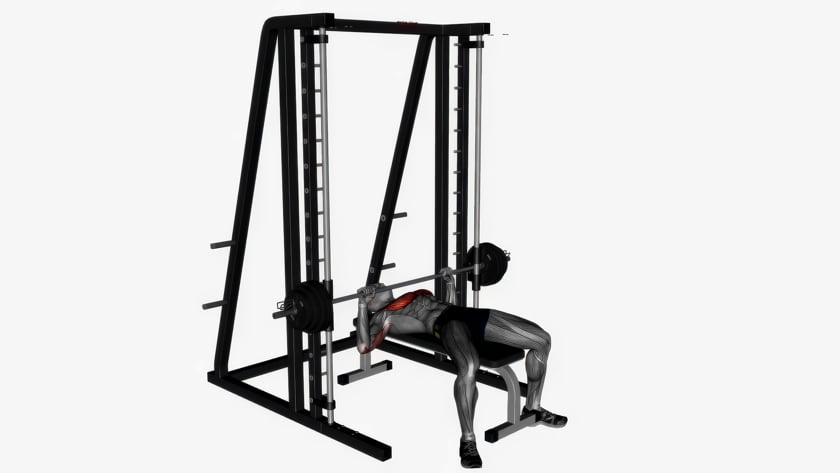
The Smith Machine Press – Flat is a fundamental chest exercise that uses the same basic horizontal pressing pattern as a traditional barbell bench press while guiding the bar along the Smith machine’s fixed track. The exercise primarily targets the pectoralis major, with the triceps and anterior deltoids assisting during the pressing movement. NASM identifies these same muscles as the primary contributors during the bench press.
As demonstrated in the uploaded video, the exercise is performed lying face-up on a flat bench positioned beneath the Smith machine bar. The feet remain firmly planted on the floor while the bar is lowered toward the chest and then pressed upward in a controlled motion.
The Smith machine can be particularly useful for beginning exercisers because the bar moves along a guided linear path. NSCA describes the Smith machine as a rod or linear-guided machine that increases stability by limiting movement to a straight path.
How to Perform
Position a flat bench beneath the Smith machine so the bar is aligned approximately over the middle of your chest.
Lie on the bench with your head, upper back and hips supported. Place both feet firmly on the floor to create a stable base.
Grasp the bar with a closed grip, placing your hands approximately shoulder-width apart or slightly wider. Keep your wrists relatively straight and positioned under the bar.
Brace your abdominal muscles and gently draw your shoulder blades back against the bench.
Rotate or release the Smith machine bar from its safety hooks and position it above your chest.
Slowly bend your elbows and lower the bar toward the middle of your chest. Keep the movement smooth and controlled.
Press the bar upward by extending your elbows until your arms are comfortably extended. Avoid forcefully locking the elbows.
Continue for the desired number of repetitions while maintaining consistent body position and control. NASM’s bench-press guidance emphasizes stable five-point body contact, a secure grip, neutral wrist positioning and controlled lowering and pressing.
Tips
Take time to correctly position the bench before beginning. Because the Smith machine bar follows a fixed path, bench placement should allow the bar to lower comfortably toward the middle of the chest.
Begin with a manageable resistance and learn the movement before increasing the load.
Keep your feet firmly planted and your head, upper back and hips supported throughout the exercise.
Keep your wrists relatively straight and directly underneath the bar rather than allowing them to bend excessively backward.
Maintain a comfortable elbow position as the bar lowers. Avoid excessively flaring the elbows directly outward.
Lower and press the bar slowly and under control. Do not bounce the bar from the chest.
Become familiar with the Smith machine’s safety hooks or stops before beginning the exercise. NSCA notes that Smith machines commonly include safety mechanisms, but a spotter may still be appropriate when needed.
Benefits
The Smith Machine Press – Flat strengthens the pectoralis major while also involving the triceps and anterior deltoids. These are the same primary muscle groups involved in the conventional bench press.
The guided bar path reduces some of the stabilization demands required during a free-weight barbell bench press. NSCA notes that linear-guided machines such as the Smith machine increase stability by restricting movement to a straight path.
This can make the Smith Machine Press useful for beginners who are learning the basic horizontal pressing pattern while still developing confidence and strength.
The machine also allows resistance to be increased gradually as technique improves. Current ACSM resistance-training guidance emphasizes progressive, individualized resistance training rather than unnecessary complexity.
Common Mistakes
Positioning the bench incorrectly can cause the bar to travel toward the neck, shoulders or abdomen rather than comfortably toward the chest.
Using too much resistance can lead to excessive arching of the lower back, lifting the hips or losing control of the bar.
Allowing the wrists to bend excessively backward reduces stability and may increase wrist discomfort.
Flaring the elbows excessively outward can place unnecessary stress on the shoulders. Keep the elbows following a comfortable path.
Lowering the bar too quickly or bouncing it from the chest reduces muscular control.
Relying on the guided bar path as a substitute for proper technique is also a mistake. Although the Smith machine increases stability, good body position and controlled movement are still essential.
FAQ
Safety Note
Make sure you understand how to operate the Smith machine’s hooks and safety stops before beginning the exercise. Position the bench carefully, use a manageable resistance and maintain control throughout every repetition.
Stop the exercise if you experience pain in the shoulders, elbows, wrists, chest or back.
If you have an existing spinal injury or chronic back pain, consult your physician or another qualified healthcare professional before performing this or any other exercise.