
Cable Middle Fly
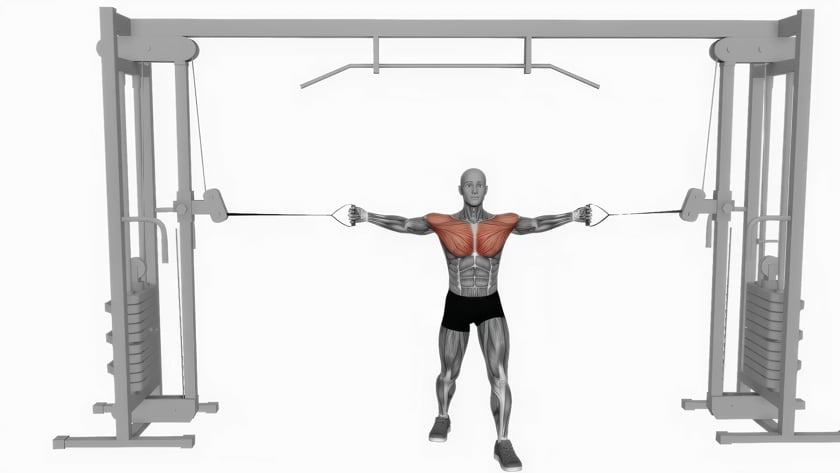
The Cable Middle Fly is a fundamental chest exercise performed on a dual-cable machine. With the pulleys positioned approximately at shoulder or chest height, the arms move forward and inward in a wide arc. The exercise primarily targets the pectoralis major while the anterior deltoids and surrounding shoulder muscles assist with movement and stabilization.
Unlike dumbbell fly variations, the cable system maintains resistance throughout much of the exercise, including as the hands come together in front of the body. NASM includes the Two-Arm Standing Cable Fly and Cable Crossover within its chest exercise library and identifies the chest, shoulders and anterior deltoids as the primary areas involved.
The movement demonstrated in the video is the middle or horizontal variation of the cable fly. The arms travel primarily forward rather than noticeably upward or downward, distinguishing it from low-to-high and high-to-low cable fly variations.
How to Perform
Position the cable pulleys at approximately shoulder or chest height and attach a single handle to each cable.
Grasp one handle in each hand and step forward into a stable stance. A staggered stance may be used to provide additional stability.
Begin with your arms extended outward to your sides and maintain a slight bend in your elbows. Keep your wrists neutral and your shoulders comfortably back and down.
Brace your abdominal muscles and maintain a stable torso without excessively arching your lower back.
Bring both arms forward and inward in a smooth, wide arc until your hands come together in front of your chest.
Pause briefly while maintaining control of the resistance.
Slowly allow your arms to open outward along the same path until you return to the starting position. Maintain the slight bend in your elbows throughout the movement.
Continue for the desired number of repetitions using a controlled and comfortable range of motion.
ACE's Standing Chest Fly guidance similarly recommends slightly bent elbows, bringing the hands together in front of the body and slowly returning to the starting position.
Tips
Choose a resistance that allows you to control both cables throughout the entire movement. The Cable Middle Fly is not an exercise that requires heavy resistance to be effective.
Maintain a slight bend in your elbows and keep that angle relatively consistent as your arms move forward and backward.
Keep your chest up and torso stable. Avoid leaning farther forward as you bring the handles together.
Think about bringing your upper arms toward one another rather than simply pulling the handles with your hands.
Keep your wrists straight and aligned with your forearms.
Allow your arms to open only as far as you can comfortably control without excessive stretching or discomfort through the front of the shoulders.
Move smoothly in both directions. Do not allow the weight stack to pull your arms rapidly backward.
Benefits
The Cable Middle Fly provides a straightforward way to train the chest through horizontal adduction, one of the primary movements produced by the pectoralis major.
The cable machine provides continuous resistance as the arms travel through the exercise, including near the point where the hands come together.
Because the resistance can be adjusted in small increments, the exercise can be easily adapted to the individual's current strength and ability.
The standing position also requires the abdominal and postural muscles to stabilize the body while the arms move against resistance.
As part of a beginner chest program, the Cable Middle Fly complements fundamental pressing movements such as push-ups and bench presses by introducing a different movement pattern without requiring complicated technique. NASM lists its Two-Arm Standing Cable Fly as a beginner exercise.
Common Mistakes
Using too much weight is one of the most common mistakes. Excessive resistance can cause the exerciser to lean forward, bend the elbows excessively or use momentum to complete the movement.
Turning the exercise into a press by repeatedly bending and straightening the elbows reduces the intended fly motion.
Allowing the shoulders to roll excessively forward as the handles come together can reduce stability and alter the movement.
Opening the arms too far behind the body may place unnecessary stress on the shoulder joints. Use a comfortable range of motion rather than attempting to achieve the largest possible stretch.
Allowing the weight stack to pull the arms rapidly backward reduces control during the return portion of the exercise.
Arching the lower back or moving the torso forward and backward indicates that the resistance may be too heavy. ACE specifically cautions against excessive forward leaning during standing cable fly variations because it can increase stress on the shoulder joint.
FAQ
Safety Note
Use a manageable resistance and maintain a stable stance throughout the exercise. Avoid excessive forward leaning, arching the lower back or allowing the cables to pull your arms rapidly backward.
Do not force your arms farther behind your body than your comfortable shoulder range of motion allows. If you experience shoulder pain or discomfort, stop the exercise and reassess your resistance, positioning and range of motion.
If you have an existing spinal injury or chronic back pain, consult your physician or another qualified healthcare professional before performing this or any other exercise.