
Dumbbell Fly – Flat Bench
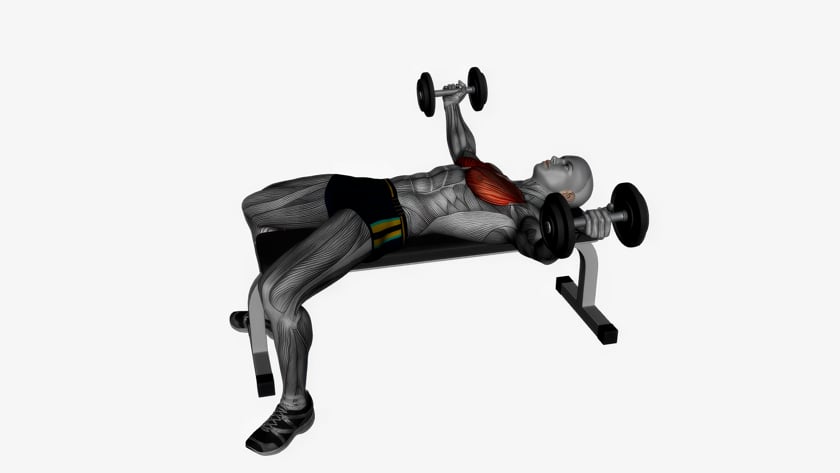
The Dumbbell Fly – Flat Bench is a classic chest exercise that primarily targets the pectoralis major while also involving the anterior deltoids and muscles responsible for stabilizing the shoulder joint. Unlike a chest press, which combines movement at the shoulders and elbows, the dumbbell fly maintains a relatively fixed elbow position and moves the arms through a wide arc. This places greater emphasis on bringing the upper arms toward the center of the body.
As demonstrated in the video, the exercise is performed lying on a flat bench with a dumbbell in each hand. The arms begin above the chest with the palms facing one another and the elbows slightly bent. The dumbbells are then lowered outward in a controlled arc before being brought back together above the chest.
ACE's exercise guidance emphasizes maintaining a slight bend in the elbows, neutral wrist position and controlled movement while keeping the head, shoulders and hips supported by the bench.
How to Perform
Lie on your back on a flat bench with your head, shoulders and hips supported. Place your feet firmly on the floor to provide a stable base.
Hold a dumbbell in each hand and extend your arms above your chest with your palms facing each other. Maintain a slight bend in your elbows and keep your wrists in a neutral position.
Gently draw your shoulder blades back and down against the bench and brace your abdominal muscles to maintain a stable torso.
Slowly lower both dumbbells outward and away from each other in a wide arc. Maintain approximately the same slight bend in your elbows throughout the movement rather than turning the exercise into a pressing motion.
Lower the dumbbells until your upper arms are approximately level with your chest or until you reach a comfortable range of motion without excessive strain through the shoulders.
Reverse the movement by bringing your arms upward and inward along the same controlled arc until the dumbbells return above your chest.
Repeat for the desired number of repetitions while maintaining control and consistent body positioning. ACE specifically recommends a slow, controlled arc with the elbows slightly flexed and the wrists neutral throughout the exercise.
Tips
Use lighter dumbbells than you would normally use for a dumbbell chest press. The extended arm position increases the leverage placed on the chest and shoulder, so heavy resistance is generally unnecessary.
Maintain a slight bend in your elbows throughout the exercise. Avoid repeatedly bending and straightening the elbows as the dumbbells move.
Keep your shoulder blades gently drawn back against the bench and avoid allowing your shoulders to roll excessively forward as the dumbbells return to the starting position.
Lower the dumbbells only as far as your comfortable shoulder mobility allows. A greater range of motion is not automatically better, particularly if it causes discomfort in the front of the shoulder.
Move both dumbbells at approximately the same speed and through a similar range of motion.
Avoid using momentum. The effectiveness of the exercise comes from controlling the dumbbells through the entire movement rather than simply moving them from one position to another.
Benefits
The Dumbbell Fly provides a simple way to train the chest through horizontal adduction — bringing the upper arms inward toward the center of the body.
Because the elbows remain slightly bent rather than repeatedly flexing and extending as they do during a chest press, the exercise provides a different training stimulus for the chest.
Using two independent dumbbells requires each arm to control its own resistance while the muscles surrounding the shoulders help stabilize the movement.
The Dumbbell Fly also complements fundamental pressing exercises such as push-ups, dumbbell chest presses and barbell bench presses without requiring complicated equipment or technique.
For a beginner program, exercises do not need to be overly complicated to be effective. ACSM's 2026 resistance-training guidance emphasizes consistency, individualized programming and gradual progression rather than unnecessary complexity or advanced training methods.
Common Mistakes
Using dumbbells that are too heavy can make it difficult to control the movement and may place unnecessary stress on the shoulder joints.
Lowering the arms too far below the level of the chest can increase stress on the shoulders without necessarily improving the exercise.
Keeping the elbows completely straight increases the lever arm and can make the movement more difficult to control. Maintain a slight bend in the elbows throughout the exercise.
Bending and straightening the elbows excessively changes the movement from a fly toward a dumbbell press.
Allowing the dumbbells to drop quickly during the lowering phase reduces muscular control and increases the challenge of safely reversing the movement.
Arching the lower back excessively or lifting the hips from the bench reduces stability. Keep your body comfortably supported throughout the exercise.
ACE's technique guidance specifically emphasizes maintaining the slightly flexed elbow position, neutral wrists and controlled movement rather than allowing body position to change during the exercise.
FAQ
Safety Note
Use a manageable resistance and maintain control throughout the entire movement. Avoid forcing the arms into an excessive range of motion, particularly if you experience discomfort in the shoulders.
Keep a slight bend in the elbows and maintain stable wrist and shoulder positioning. A spotter may be appropriate when using heavier dumbbells; ACE specifically recommends spotter assistance when necessary during the lying chest fly.
If you have an existing spinal injury or chronic back pain, consult your physician or another qualified healthcare professional before performing this or any other exercise.