
Dumbbell Chest Press – Flat Bench
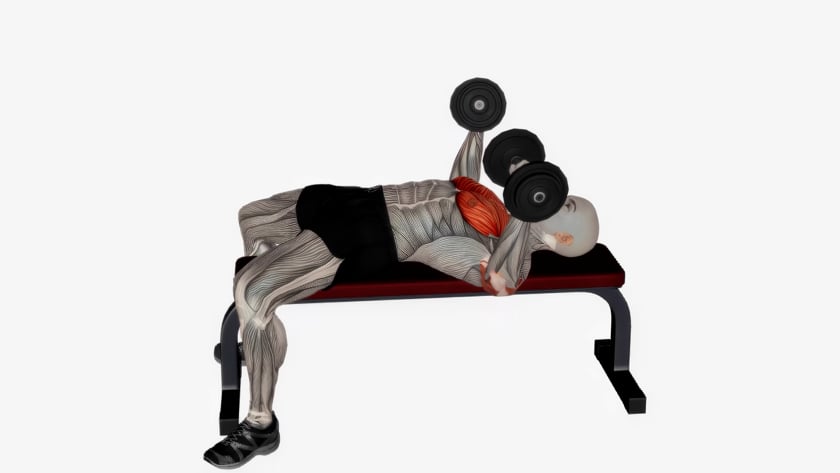
The Dumbbell Chest Press – Flat Bench is a fundamental upper-body strength exercise that primarily targets the chest while also involving the triceps and front of the shoulders. It uses the same basic horizontal pressing pattern as the barbell bench press, but the dumbbells allow each arm to move independently.
As demonstrated in the video, the exercise is performed lying face-up on a flat bench with a dumbbell in each hand. The weights are lowered under control to the sides of the chest and then pressed upward until the arms are extended above the chest. The feet remain firmly positioned on the floor to provide a stable base throughout the exercise.
The dumbbell chest press is particularly useful for developing basic pressing strength and coordination and is a common foundational exercise in resistance-training programs.
How to Perform
Sit on the end of a flat bench with a dumbbell in each hand. Carefully lie back on the bench and position the dumbbells at approximately chest level.
Place your feet firmly on the floor. Keep your head, shoulders and hips supported by the bench and maintain a stable torso throughout the exercise.
Position the dumbbells to the sides of your chest with your palms facing generally forward. Keep your wrists relatively straight and aligned with your forearms.
Press both dumbbells upward in a smooth, controlled motion until your arms are extended above your chest. Avoid forcefully locking the elbows at the top.
Slowly lower the dumbbells back toward the sides of your chest by bending your elbows. Maintain control of the weights and use a comfortable range of motion.
Continue for the desired number of repetitions while maintaining proper alignment and control.
Tips
Begin with a manageable resistance that allows you to learn the movement and maintain good technique throughout each repetition.
Keep both feet firmly planted on the floor and maintain stable contact with the bench. Avoid excessive arching of the lower back or lifting the hips from the bench.
Keep the wrists aligned with the forearms rather than allowing them to bend backward under the weight.
Lower the dumbbells under control. Avoid dropping the weights rapidly toward the chest or using momentum to begin the next repetition.
Keep the movement smooth and coordinated so both dumbbells rise and lower at approximately the same rate.
Do not force the elbows excessively below the level of the torso if doing so causes shoulder discomfort. Use a comfortable range of motion appropriate for your mobility.
Benefits
The Dumbbell Chest Press develops strength in the pectoralis major while also strengthening the triceps and anterior deltoids.
Because each arm controls its own dumbbell, the exercise requires independent control of the left and right sides. This can help develop coordination and make differences between sides more apparent than when both hands are connected to a single barbell.
The exercise also teaches the fundamental horizontal pressing pattern used in many other upper-body exercises and everyday pushing movements.
The ability to select relatively light dumbbells makes the exercise easy to scale for different strength levels, while progressively heavier dumbbells can be introduced as strength and technique improve.
Common Mistakes
Using dumbbells that are too heavy can make it difficult to control the weights and may cause the elbows, shoulders or wrists to move out of proper alignment.
Allowing the wrists to bend excessively backward places unnecessary stress on the wrists and makes the dumbbells more difficult to control.
Flaring the elbows excessively away from the body can place additional stress on the shoulders. The elbows should follow a comfortable path as the dumbbells are lowered.
Bouncing the dumbbells at the bottom of the movement or rapidly dropping them toward the chest reduces control and should be avoided.
Excessively arching the lower back or lifting the hips from the bench can indicate that the resistance is too heavy or that proper body position has been lost.
Bringing the dumbbells forcefully together at the top of the movement is unnecessary. Complete the press under control while maintaining stable shoulder and wrist positioning.
FAQ
Safety Note
Use a weight that can be controlled throughout the entire range of motion. Avoid excessively heavy dumbbells that make it difficult to maintain stable shoulder, elbow or wrist positioning.
Use care when getting the dumbbells into and out of the starting position, particularly as resistance increases. A spotter may be appropriate when using heavier weights. Stop the exercise if you experience shoulder, elbow, wrist or chest pain.
If you have an existing spinal injury or chronic back pain, consult your physician or another qualified healthcare professional before performing this or any other exercise.