
Two-Arm Reverse Wrist Curl
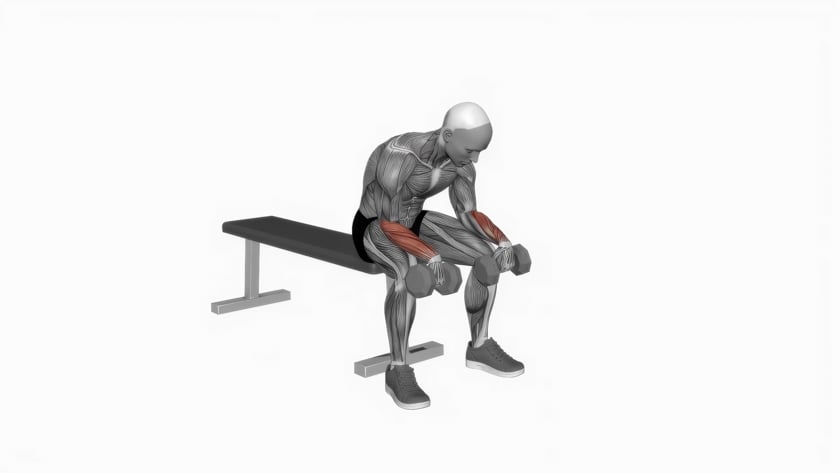
The Two-Arm Reverse Wrist Curl is a forearm-strengthening exercise that primarily targets the muscles along the back, or top, of the forearms that extend and stabilize the wrists. Wrist-extension exercises are recognized as fundamental forearm movements by organizations including ACE and NASM.
As demonstrated in the video, the exercise is performed seated with a dumbbell in each hand and both forearms supported on the thighs. The palms face downward while the hands and dumbbells extend beyond the knees, allowing both wrists to move freely.
Unlike a traditional wrist curl, which emphasizes the forearm flexors with the palms facing upward, this reverse position emphasizes the wrist extensors. Performing the exercise with both arms simultaneously provides a simple and efficient way to strengthen both forearms while also encouraging balanced wrist control.
How to Perform
Sit near the edge of a bench with your feet comfortably positioned on the floor.
Hold a dumbbell in each hand using an overhand grip with your palms facing downward.
Lean slightly forward and place your forearms on your thighs. Position your hands just beyond your knees so your wrists can move freely.
Begin with your wrists in a comfortable neutral position and keep your forearms supported throughout the exercise.
Slowly lower the dumbbells by allowing your wrists to flex downward while maintaining a secure grip.
From the lowered position, contract the muscles along the top of your forearms and extend both wrists upward, raising the dumbbells as far as comfortably possible.
Pause briefly at the top of the movement.
Slowly lower the dumbbells back to the starting position and repeat for the desired number of repetitions.
Keep the movement controlled in both directions. ACE similarly instructs exercisers to keep the forearms supported and use the wrist extensor muscles to raise the dumbbells without extending the arms or using body movement.
Tips
Use relatively light dumbbells. The muscles controlling wrist extension are comparatively small and do not require heavy resistance to be effectively challenged.
Keep your palms facing downward throughout the exercise.
Maintain contact between your forearms and thighs. Avoid lifting your elbows or forearms as you raise the dumbbells.
Move both wrists together at approximately the same speed and through a similar comfortable range of motion.
Keep a secure grip on the dumbbells throughout the exercise rather than allowing them to roll toward your fingertips.
Raise and lower the dumbbells slowly. ACSM resistance-training guidance emphasizes performing repetitions with good form and controlling both the lifting and lowering portions of an exercise.
Avoid forcing the wrists upward or downward beyond their natural range of motion.
Benefits
The Two-Arm Reverse Wrist Curl strengthens the wrist extensor muscles located along the back of the forearms. ACE specifically classifies wrist-extension exercises as exercises for the arm extensors.
Strengthening the wrist extensors complements wrist-curl exercises that emphasize the muscles on the opposite side of the forearm, helping provide more balanced forearm training.
Stronger wrist extensors can improve wrist stability and control during resistance-training exercises that require holding dumbbells, barbells, cables and other equipment.
Developing forearm strength can also support grip-intensive activities and everyday tasks that require controlling, carrying or manipulating objects.
Performing both arms simultaneously makes the exercise time-efficient while still requiring each hand and forearm to independently control its dumbbell.
Common Mistakes
Using dumbbells that are too heavy can cause the elbows, shoulders or upper body to assist with the movement rather than keeping the exercise focused on the wrists.
Lifting the forearms away from the thighs reduces the isolation of the wrist extensors.
Moving the dumbbells quickly or bouncing through the bottom of the movement uses momentum instead of controlled muscular effort.
Allowing the wrists to rotate so the palms begin facing inward changes the intended exercise. Keep the palms facing downward throughout the movement.
Trying to achieve an excessive range of motion can place unnecessary stress on the wrists. Use a comfortable range that can be controlled from beginning to end.
Allowing one wrist to move substantially faster or farther than the other can reduce the benefit of performing the exercise simultaneously.
FAQ
Safety Note
Use a resistance that allows you to maintain complete control throughout the exercise. Keep the forearms supported, maintain a secure grip and avoid forcing the wrists beyond a comfortable range of motion.
Stop the exercise if you experience sharp pain, unusual wrist discomfort, numbness or tingling in the hands or forearms.
If you have an existing wrist, hand, elbow or forearm injury or another condition that may affect your ability to perform this exercise safely, consult your physician or another qualified healthcare professional before performing this or any other exercise.