
Dumbbell Lying Pronation/Supination
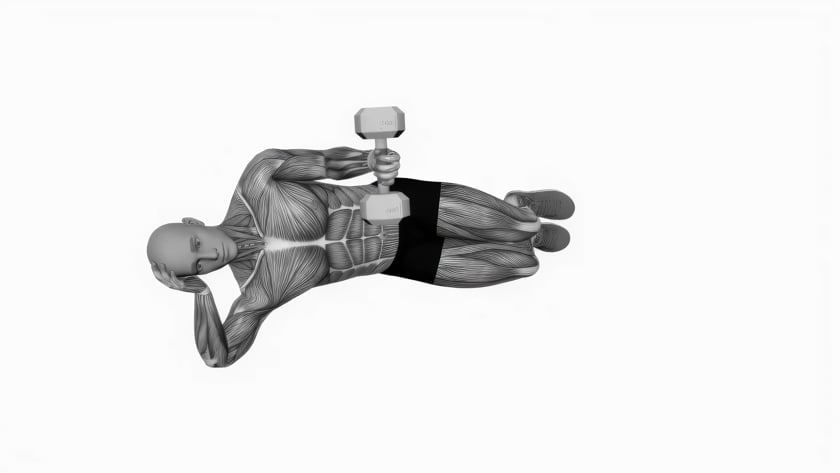
The Dumbbell Lying Pronation/Supination is a forearm-strengthening exercise that focuses on the rotational movement of the forearm.
Pronation rotates the forearm so the palm turns downward, while supination rotates it in the opposite direction so the palm turns upward. These movements are important for wrist and forearm control during many everyday, recreational and resistance-training activities.
As demonstrated in the video animation, the exercise is performed lying on the side while holding a dumbbell vertically with the working elbow bent and positioned close to the body. The forearm rotates the dumbbell through a controlled arc while the upper arm and elbow remain relatively stationary.
Because the dumbbell creates increasing leverage as it rotates away from vertical, this exercise requires very little weight. The emphasis should be on smooth rotation, control and a comfortable range of motion rather than heavy resistance.
How to Perform
Lie on your side in a comfortable position with your head supported by your lower arm.
Hold a light dumbbell in your upper hand and bend the working elbow to approximately 90 degrees.
Keep the upper arm close to your side and position the forearm so the dumbbell begins approximately vertical.
Maintain a firm grip and keep the wrist straight rather than allowing it to bend forward, backward or sideways.
Slowly rotate the forearm in one direction, allowing the dumbbell to move through a comfortable arc. The movement should come from rotation of the forearm rather than movement of the shoulder or upper arm.
Pause briefly at the end of the comfortable range.
Slowly reverse the movement by rotating the forearm in the opposite direction.
Continue alternating between pronation and supination for the desired number of repetitions while maintaining control throughout the movement. We similarly recommend maintaining a neutral wrist and slowly rotating through pronation and supination without jerking the resistance.
Tips
Use a very light dumbbell when first learning this exercise. The leverage created by the dumbbell can make even a relatively small weight challenging.
Keep the elbow bent and the upper arm close to the body throughout the exercise.
Maintain a straight, neutral wrist. The exercise involves rotation of the forearm rather than flexing or extending the wrist.
Rotate slowly in both directions and maintain control as the dumbbell approaches the end of your comfortable range. We caution against rapid or jerking movements during resisted pronation and supination.
Do not force the forearm to rotate farther than feels natural. Individual range of motion will vary.
Keep a secure grip on the dumbbell throughout each repetition.
FAQ
Safety Note
Use a light resistance that allows you to control the dumbbell throughout the entire movement. Rotate the forearm slowly, keep the wrist in a neutral position and avoid forcing the arm beyond its comfortable range of motion. ACSM's resistance-training guidance emphasizes controlled lifting and lowering with good form.
Stop the exercise if you experience sharp pain, unusual discomfort, numbness or tingling in the wrist, hand, elbow or forearm.
If you have an existing wrist, hand, elbow or forearm injury or another condition that may affect your ability to perform this exercise safely, consult your physician or another qualified healthcare professional before performing this or any other exercise.