
Dumbbell Seated Wrist Curl
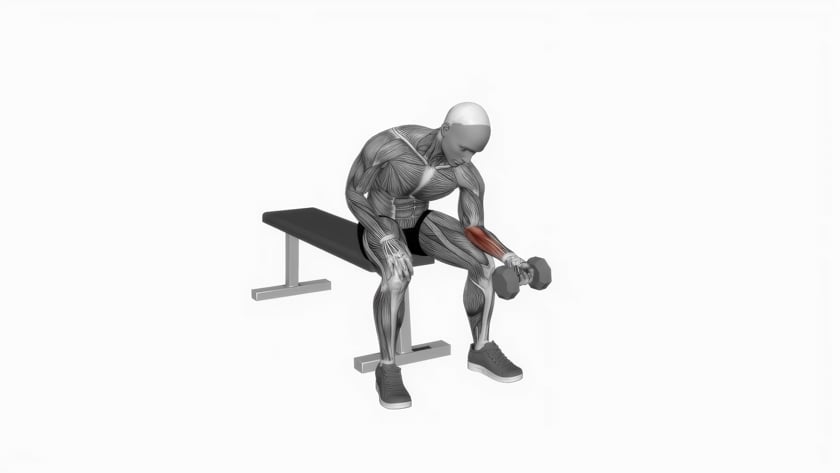
The Dumbbell Seated Wrist Curl is a simple isolation exercise designed to strengthen the muscles on the palm side of the forearm that help flex and control the wrist. It can also contribute to grip strength, which is useful for many pulling, lifting and everyday activities.
Wrist flexion or wrist curls are fundamental forearm-strengthening movements.
As demonstrated in the video animation, this version is performed one arm at a time while seated. The working forearm is supported on the thigh with the palm facing upward and the hand extending beyond the knee.
The forearm remains relatively still while the wrist moves the dumbbell through a comfortable range of motion. This unilateral setup allows the exerciser to concentrate on controlled movement of each wrist independently.
How to Perform
Sit securely on a bench with your feet positioned comfortably on the floor. Hold a dumbbell in one hand with your palm facing upward.
Lean slightly forward and rest the working forearm along the same-side thigh. Position the wrist just beyond the knee so the hand and dumbbell can move freely while the forearm remains supported.
Begin with the wrist in a comfortable neutral position. Slowly lower the dumbbell by allowing the wrist to extend toward the floor while maintaining a secure grip.
Curl the dumbbell upward by flexing the wrist toward the forearm. Keep the movement controlled and avoid lifting the forearm away from the thigh.
Pause briefly near the top of the movement, then slowly lower the dumbbell back through a comfortable range of motion.
Complete the desired repetitions and repeat with the opposite arm. We emphasize keeping the forearm supported and producing the movement primarily through the wrist.
Tips
Use a relatively light dumbbell that allows you to move the wrist smoothly and under control. The forearm muscles are comparatively small, so heavy resistance is usually unnecessary for learning this movement.
Keep the forearm firmly supported against the thigh throughout the exercise. Think about moving only the hand and wrist rather than allowing the elbow, shoulder or torso to assist.
Maintain a secure grip on the dumbbell during both the lifting and lowering phases. We caution against deliberately allowing the dumbbell to roll toward the fingertips because doing so may increase the risk of losing control of the weight.
Use a comfortable range of motion. Do not force the wrist farther into extension or flexion simply to increase the distance traveled.
Benefits
The Dumbbell Seated Wrist Curl directly strengthens the wrist flexors and can improve the ability to control wrist flexion against resistance. Stronger forearms can also support grip performance during many other resistance-training exercises and everyday activities requiring the hands to hold or carry objects.
The one-arm version also makes it easy to train each side independently and concentrate on controlled wrist movement without relying on momentum from the opposite arm.
As part of a balanced forearm program, wrist-flexion exercises can be paired with wrist-extension exercises to train both sides of the forearm.
Common Mistakes
Using too much weight is a common mistake. Excessive resistance can shorten the range of motion and encourage the exerciser to move the elbow, shoulder or torso rather than isolating the wrist.
Another mistake is lifting the forearm away from the thigh during the curl. The forearm should remain supported so that most of the movement occurs at the wrist.
Moving too quickly or bouncing the dumbbell at the bottom of the exercise reduces control and may place unnecessary stress on the wrist.
Allowing the dumbbell to roll loosely into the fingertips can also make the weight more difficult to control. Maintain a secure grip throughout the repetition.
FAQ
Safety Note
Use a resistance that allows controlled wrist movement without pain or excessive strain. Keep a secure grip on the dumbbell and avoid forcing the wrist beyond a comfortable range of motion.
Stop the exercise if you experience sharp pain, significant wrist discomfort, numbness or tingling in the hand or forearm.
If you have an existing wrist, hand, elbow or forearm injury or another condition that may affect your ability to perform this exercise safely, consult your physician or another qualified healthcare professional before performing this or any other exercise.