
Barbell Lying Triceps Extension / Skull Crusher
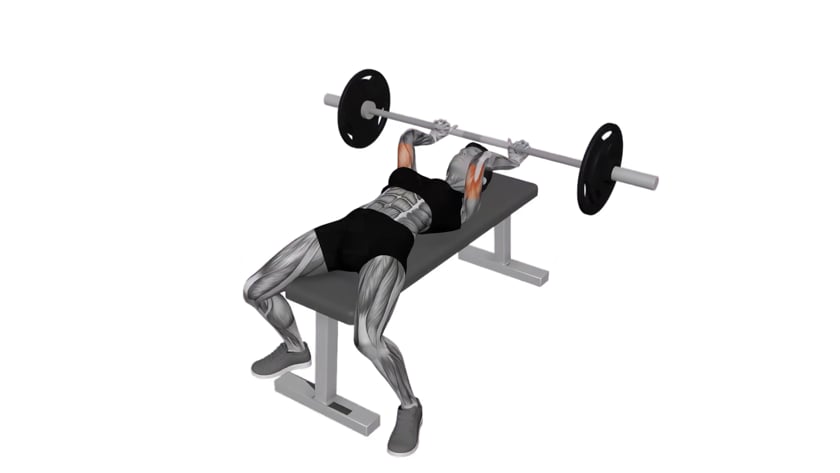
The Barbell Lying Triceps Extension, commonly called a Skull Crusher, is an isolation exercise that targets the triceps through repeated elbow flexion and extension.
As demonstrated in the uploaded video animation, the exercise is performed lying face-up on a flat bench while holding a straight barbell above the upper body.
The elbows bend to lower the bar toward the forehead and then straighten to return the bar to the starting position. Despite the colorful name "Skull Crusher," this should always be a slow and controlled movement.
The goal is not to lower the bar as close to the head as possible, but to maintain control while allowing the triceps to perform the work.
How to Perform
Lie face-up on a flat bench with your feet firmly positioned on the floor. Hold the barbell with a closed overhand grip and position your hands approximately shoulder-width apart.
Extend your arms so the barbell is positioned above your upper chest and face. Keep your wrists straight and securely wrapped around the bar.
Brace your abdominal muscles and maintain a stable position on the bench.
Keeping your upper arms relatively stationary, slowly bend your elbows and lower the bar toward your forehead or slightly behind your head. We recommend maintaining the upper arms approximately vertical to the floor during the lowering phase.
Lower the bar only as far as you can comfortably control without allowing the upper arms to move excessively.
Contract your triceps and straighten your elbows to raise the bar back to the starting position.
Continue for the desired number of repetitions using a slow and controlled movement.
Tips
Start with a relatively light barbell until you are comfortable controlling the movement. Because the bar travels toward the head, control is much more important than the amount of weight being lifted.
Keep your upper arms relatively stationary while your forearms move. Think about bending and straightening the elbows rather than moving the entire arm.
Keep your elbows approximately shoulder-width apart instead of allowing them to flare widely outward. We recommend maintaining this position throughout the exercise.
Maintain a neutral wrist position. Avoid allowing the wrists to bend backward as the bar approaches your head.
Lower the bar slowly rather than allowing gravity to accelerate the downward movement. We recommend performing lying triceps extensions with slow, controlled motion rather than relying on momentum.
Keep your feet securely positioned and maintain a stable torso throughout the exercise.
Benefits
The Barbell Lying Triceps Extension directly strengthens the triceps brachii, the primary muscle responsible for extending the elbow.
Because the exercise minimizes movement at the shoulder when performed correctly, it provides a focused way to train the triceps through elbow extension.
Strengthening the triceps can support performance in other upper-body pushing movements, including bench presses, push-ups and overhead presses.
Using a barbell allows both arms to work together against the same resistance and provides a straightforward method for gradually increasing resistance as strength improves.
The exercise provides a different resistance pattern from cable pushdowns, kickbacks and overhead extensions, making it a useful addition to a well-rounded triceps program.
Common Mistakes
Using too much weight can make it difficult to control the bar and often causes excessive movement at the shoulders. Choose resistance that allows every repetition to remain controlled.
Allowing the upper arms to move excessively forward and backward changes the exercise mechanics. Keep the upper arms relatively stationary while the elbows bend and straighten.
Allowing the elbows to flare widely outward can reduce control of the movement. Keep them approximately shoulder-width apart.
Bending the wrists backward while holding the bar can create unnecessary stress. Maintain a neutral wrist position throughout the exercise.
Lowering the bar too quickly toward the forehead is an obvious safety concern. The lowering phase should always be deliberate and controlled.
Bouncing out of the bottom position or using momentum reduces the emphasis on the triceps and makes the movement more difficult to control.
FAQ
Safety Note
Because the barbell travels toward the head, use a manageable amount of resistance and maintain complete control during every repetition. Keep a secure closed grip on the bar, maintain neutral wrists and never allow the bar to drop quickly toward the forehead. A spotter is a sensible precaution when using heavier resistance.
Stop the exercise if you experience pain or unusual discomfort in your elbows, wrists or shoulders. If you have an existing injury or medical condition that may affect your ability to exercise safely, consult your physician or another qualified healthcare professional before performing this or any other exercise.