
Bench Dip (Knees Bent)
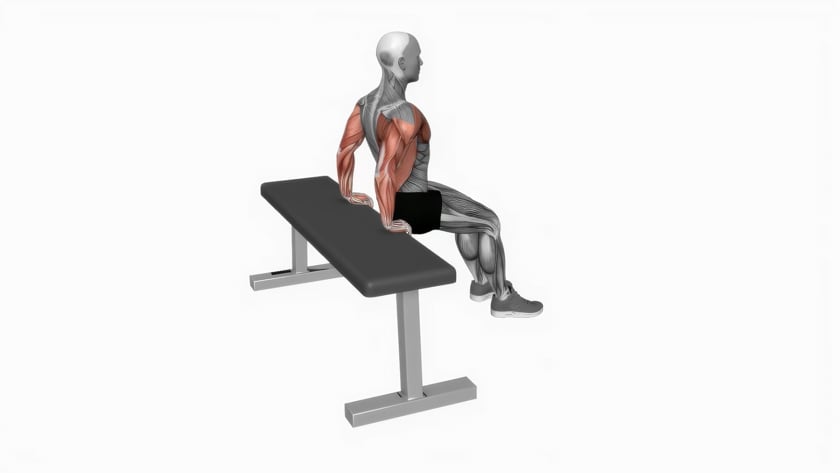
The Bench Dip (Knees Bent) is a bodyweight exercise that primarily strengthens the triceps while also involving the chest and front of the shoulders.
Bending the knees and keeping the feet relatively close to the bench reduces the amount of bodyweight supported by the arms, making this version more accessible than a bench dip performed with the legs fully extended. The bent-knee position is a way to reduce the difficulty of the bench dip.
As demonstrated in the uploaded video animation, the exerciser sits at the edge of a flat bench with the hands positioned beside the hips and the knees bent. The hips move just forward of the bench while the elbows bend to lower the body and then extend to press the body upward.
Keeping the torso relatively close to the bench and the elbows directed behind the body helps maintain the emphasis on the triceps.
How to Perform
Sit on the edge of a sturdy flat bench with your knees bent and your feet flat on the floor. Place your hands on the edge of the bench beside your hips with your fingers facing forward.
Press through your hands and carefully move your hips just beyond the edge of the bench. Keep your chest lifted, shoulders down and abdominal muscles engaged.
Slowly bend your elbows and lower your body toward the floor. Keep your elbows pointing generally behind you rather than allowing them to flare widely outward.
Lower your body only as far as you can comfortably control. Approximately a 90-degree bend at the elbows is a common stopping point, provided that position feels comfortable at the shoulders.
Press firmly through your hands and straighten your elbows to raise your body back toward the starting position.
Continue for the desired number of repetitions while keeping the movement slow and controlled.
Tips
Keep your hips relatively close to the edge of the bench throughout the exercise. Allowing the body to move too far forward can change the mechanics of the movement and increase stress at the shoulders.
Keep your shoulders down and away from your ears rather than allowing them to shrug upward as you lower yourself. Shoulder shrugging is a common bench-dip error.
Keep your elbows directed behind you rather than allowing them to flare outward. This helps maintain the intended triceps emphasis and provides better control of the movement.
Use your arms to raise and lower your body rather than pushing excessively through your legs. We emphasize raising the body using the arms rather than the legs.
The closer your feet are to the bench, the easier the exercise generally becomes. As strength improves, the feet can gradually be moved farther away to increase the amount of bodyweight supported by the upper body.
Benefits
The Bench Dip (Knees Bent) provides an effective way to strengthen the triceps using bodyweight resistance and minimal equipment.
The bent-knee position makes the exercise easier to control than the straight-leg variation, providing a useful starting point for exercisers developing sufficient upper-body strength for more challenging dip variations.
Although the triceps are the primary target, the chest and anterior shoulder muscles also assist with the movement.
Strengthening the triceps supports many other upper-body pushing movements, including push-ups and pressing exercises.
Common Mistakes
Moving the hips too far away from the bench changes the position of the shoulders and can make the movement more difficult to control. Keep the body close to the bench throughout each repetition.
Allowing the elbows to flare excessively outward can reduce the intended triceps emphasis. Keep the elbows pointing generally behind the body as they bend.
Shrugging the shoulders toward the ears can place unnecessary stress on the shoulder area. Keep the shoulders down and maintain an open chest throughout the movement.
Dropping too deeply can place unnecessary stress on the shoulders. Do not assume that a deeper dip is automatically better. Lower only through a comfortable, controlled range of motion.
Using momentum to bounce out of the bottom position reduces muscular control. Lower and raise the body smoothly during every repetition.
Relying heavily on the legs to push the body upward reduces the workload placed on the triceps. The feet should provide stability while the arms perform most of the pressing action.
FAQ
Safety Note
The Bench Dip places the shoulder in an extended position behind the body, so range of motion should be based on individual shoulder mobility and comfort. Keep the body close to the bench, avoid excessive depth and never force the shoulders into an uncomfortable position. ACE specifically notes that, despite the high triceps activation produced by bench dips, the exercise may create increased stress across the front of the shoulder joint.
Stop the exercise if you experience pain or unusual discomfort in your shoulders, elbows, wrists, chest or back. If you have an existing injury or medical condition that may affect your ability to exercise safely, consult your physician or another qualified healthcare professional before performing this or any other exercise.