
Close-Grip Barbell Bench Press
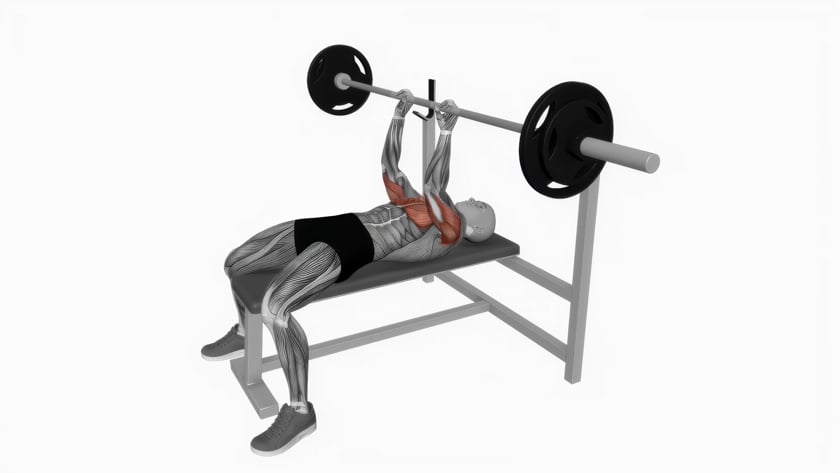
The Close-Grip Barbell Bench Press is a compound upper-body exercise that emphasizes the triceps while also working the chest and front of the shoulders. It uses the familiar bench-press movement but places the hands closer together than during a traditional barbell bench press.
This narrower grip increases the contribution of the triceps as the elbows straighten and the bar is pressed away from the chest.
The uploaded video animation demonstrates the exercise on a flat bench using a barbell. The hands are positioned approximately shoulder-width apart rather than using an excessively narrow grip, and the elbows remain relatively close to the torso as the bar is lowered and pressed upward.
This is an important distinction because "close grip" does not mean the hands need to touch. We caution against an excessively narrow grip that can place unnecessary stress on the wrists.
Because several muscle groups work together, the Close-Grip Barbell Bench Press can be used to develop triceps strength while also improving general upper-body pressing strength.
How to Perform
Lie face up on a flat bench with your head, shoulders and hips supported. Place your feet firmly on the floor to create a stable base.
Grasp the barbell with a closed, overhand grip approximately shoulder-width apart or slightly narrower. Keep your wrists comfortably aligned with your forearms.
Carefully unrack the bar and position it above your chest with your arms extended. Keep your shoulder blades stable against the bench and brace your abdominal muscles.
Slowly bend your elbows and lower the bar toward your chest. Keep the elbows relatively close to your sides rather than allowing them to flare widely outward.
Press the bar upward by extending your elbows until your arms are comfortably straight. Concentrate on using the triceps while keeping your shoulders and torso stable.
Continue for the desired number of repetitions, maintaining control during both the lowering and pressing phases.
Exercisers should keep the elbows close to the ribs while lowering the bar and to maintain firm contact between the feet and floor during the press.
Tips
Use a moderately narrow grip. The hands do not need to be extremely close together. A grip around shoulder width or slightly narrower provides the intended triceps emphasis while allowing more comfortable wrist and elbow alignment.
Keep your wrists aligned. Avoid allowing the bar to roll backward toward the fingers or excessively bend the wrists. We emphasize keeping the bar supported over the heel of the hand and avoiding excessive wrist extension during bench pressing.
Keep your elbows under control. Allow the elbows to track naturally close to the torso instead of flaring them widely outward.
Maintain a stable base. Keep your feet firmly on the floor and your upper body securely positioned on the bench throughout the exercise.
Control the bar. Lower and press the bar smoothly rather than bouncing it off the chest or using momentum.
Use an appropriate weight. The close-grip position may require less resistance than you use during a traditional bench press. Begin conservatively and increase resistance as strength and technique improve.
Benefits
Strengthens the triceps. The narrower hand position increases the contribution of the triceps during the pressing movement. NASM identifies the triceps brachii as a primary muscle during the Close-Grip Bench Press.
Develops upper-body pressing strength. The exercise trains the coordinated action of the triceps, chest and shoulders, making it useful for developing overall pressing strength.
Provides a compound triceps exercise. Unlike isolation exercises such as kickbacks and pushdowns, the Close-Grip Barbell Bench Press involves movement at both the elbow and shoulder joints and allows several upper-body muscles to work together.
Complements other triceps exercises. Combining compound pressing movements with isolation exercises provides different ways to train the triceps within a balanced resistance-training program.
Builds strength that carries over to other pressing movements.
Common Mistakes
Using an excessively narrow grip. Bringing the hands too close together can create an awkward wrist position without providing a meaningful advantage. We caution against excessively narrow hand placement because it can increase wrist stress.
Allowing the elbows to flare outward. Excessive elbow flare changes the mechanics of the exercise and can reduce the intended triceps emphasis. We recommend keeping the elbows close to the ribs during the movement.
Bending the wrists backward. Keep the wrists comfortably aligned with the forearms and the bar positioned securely over the hands.
Bouncing the bar off the chest. Lower the bar under control and reverse direction smoothly rather than using the chest to create momentum.
Using too much weight. Excessive resistance can cause loss of control, excessive back arching or changes in elbow and wrist position.
Lifting the feet or hips. Keep the feet firmly planted and maintain a stable position on the bench rather than shifting the body to help move the bar.
FAQ
Safety Note
Perform the Close-Grip Barbell Bench Press using a secure grip and a resistance you can control throughout the entire movement. Keep your wrists comfortably aligned, maintain a stable position on the bench and avoid using an excessively narrow grip. When training with a loaded barbell, use appropriate safety supports or a qualified spotter whenever necessary.
Stop the exercise if you experience pain or unusual discomfort in your shoulders, elbows, wrists or chest. If you have an existing injury or medical condition that may affect your ability to exercise safely, consult your physician or another qualified healthcare professional before performing this or any other exercise.