
Standing Dumbbell Curl
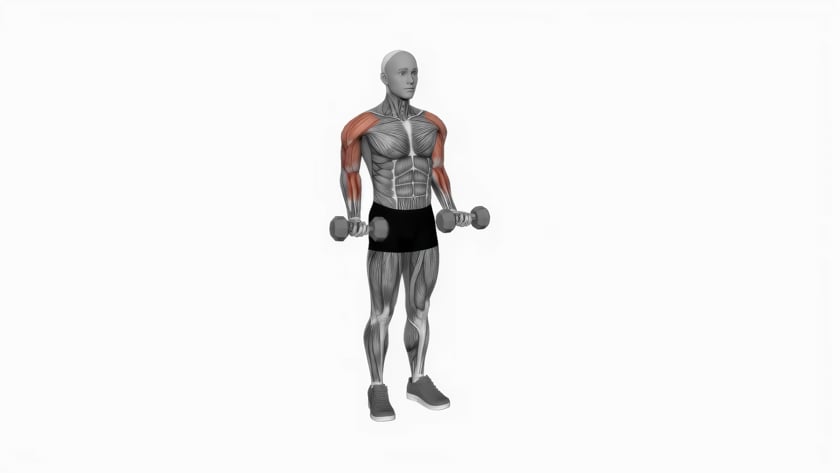
The Standing Dumbbell Curl is a fundamental upper-body strength exercise that primarily targets the biceps brachii, the muscles located along the front of the upper arms. The brachialis, brachioradialis and forearm muscles also assist with bending and controlling the elbow.
Unlike a barbell curl, dumbbells allow each arm to work independently, which can help develop balanced strength between the left and right sides. The uploaded video demonstrates both dumbbells being curled simultaneously with the palms facing forward while the upper arms remain close to the torso.
This straightforward movement makes the Standing Dumbbell Curl an excellent foundational exercise for developing arm strength and learning controlled elbow flexion.
How to Perform
Stand upright with your feet approximately hip- to shoulder-width apart and hold a dumbbell in each hand.
Allow your arms to hang naturally at your sides with your palms facing forward.
Keep your chest lifted, shoulders relaxed and abdominal muscles gently engaged.
Position your elbows close to your sides and keep your wrists straight and aligned with your forearms.
Keeping your upper arms relatively stationary, bend both elbows and curl the dumbbells upward toward your shoulders.
Continue lifting until you reach a comfortable full contraction of the biceps without allowing your elbows to travel significantly forward.
Pause briefly at the top and squeeze your biceps.
Slowly lower both dumbbells under control until your arms return to the starting position.
Repeat for the desired number of repetitions.
ACE recommends keeping the elbows close to the sides, avoiding excessive forward elbow movement and maintaining neutral wrist alignment during dumbbell curls.
Tips
Keep your elbows close to your sides throughout the exercise.
Maintain an upright posture rather than leaning backward as the dumbbells rise.
Keep your wrists straight instead of bending them forward or backward.
Use a weight that allows you to complete each repetition without swinging your torso.
Concentrate on bending at the elbows while keeping your shoulders relaxed.
Squeeze the biceps briefly at the top of the movement.
Lower the dumbbells slowly and under control rather than allowing gravity to drop them.
Benefits
Strengthens the biceps brachii and the muscles that assist with elbow flexion.
Allows each arm to work independently, helping develop balanced strength between the left and right sides.
Strengthens the brachialis, brachioradialis and forearm muscles.
Develops arm strength useful for lifting, carrying and pulling activities.
Requires the abdominal and postural muscles to stabilize the torso while standing.
Provides a simple exercise that can be progressively loaded as strength improves.
The dumbbell curl fits within established resistance-training principles emphasizing controlled resistance exercise and progressive loading. ACSM's current resistance-training position stand notes that a wide variety of resistance-training methods can effectively improve strength and muscular development and that programming should be matched to the individual's abilities and goals.
Common Mistakes
Swinging the dumbbells or torso to create momentum.
Leaning backward to help lift weights that are too heavy.
Allowing the elbows to move excessively forward during the curl.
Letting the elbows flare away from the body.
Shrugging the shoulders as the dumbbells rise.
Bending the wrists instead of keeping them aligned with the forearms.
Dropping the dumbbells too quickly during the lowering phase.
Using a shortened range of motion instead of performing smooth, controlled repetitions.
ACE specifically emphasizes avoiding back arching, forward elbow movement, shoulder shrugging and wrist flexion or extension during dumbbell curls.
FAQ
Safety Note
Choose dumbbells that allow you to maintain proper posture and controlled movement throughout every repetition.
Keep your wrists straight and comfortably aligned with your forearms.
Avoid jerking, swinging or leaning backward to lift the weights.
Maintain control during the lowering phase rather than allowing the dumbbells to drop quickly.
Keep your shoulders relaxed and avoid shrugging them toward your ears.
If you experience pain in your shoulders, elbows or wrists, discontinue the exercise and consult your physician or another qualified healthcare professional before continuing.