
Dumbbell Single Arm Row
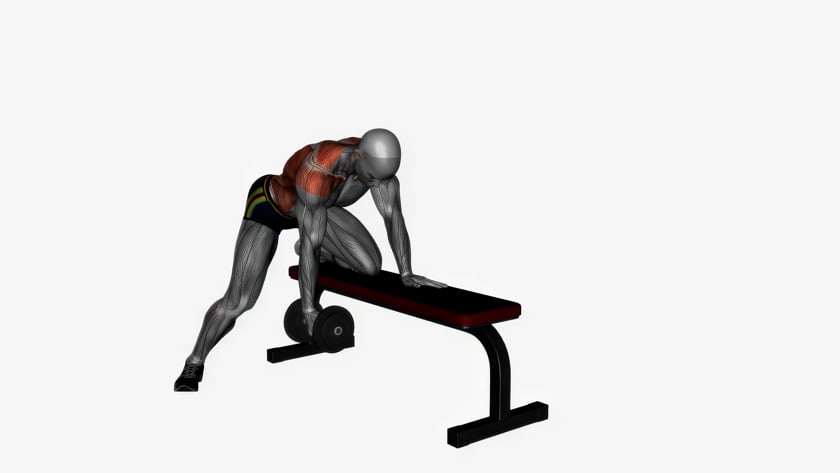
The Dumbbell Single Arm Row is a fundamental unilateral strength exercise that builds the muscles of the upper and middle back while improving balance, coordination and muscular symmetry.
Supporting your body with one hand and one knee on a bench provides stability, allowing you to focus on proper rowing mechanics and a full range of motion.
This exercise primarily targets the latissimus dorsi, rhomboids and middle trapezius while also strengthening the rear shoulders, biceps, forearms and core stabilizers.
How to Perform
Place your left knee and left hand securely on a flat bench while keeping your right foot firmly on the floor.
Hold a dumbbell in your right hand with your arm fully extended beneath your shoulder.
Maintain a flat back, brace your abdominal muscles and keep your head and neck in a neutral position.
Begin the movement by drawing your shoulder blade back and down.
Pull the dumbbell upward toward the outside of your lower ribs by driving your elbow toward the ceiling.
Pause briefly while squeezing your back muscles at the top of the movement.
Slowly lower the dumbbell until your arm is fully extended while maintaining control.
Complete all repetitions on one side before switching to the opposite arm.
Tips
Keep your back flat and your torso stable throughout the exercise.
Lead the movement with your elbow rather than pulling with your hand.
Avoid twisting your shoulders or rotating your torso as you lift the weight.
Use a full range of motion to maximize muscle activation.
Choose a weight that allows you to perform every repetition with proper technique.
Benefits
Strengthens the latissimus dorsi, rhomboids and trapezius.
Develops balanced strength between the left and right sides of the body.
Improves posture by strengthening the muscles that stabilize the shoulder blades.
Enhances shoulder stability and pulling strength.
Engages the core muscles to help maintain body position.
Helps identify and correct muscular imbalances.
Common Mistakes
Twisting the torso to lift heavier weight.
Rounding the lower back during the exercise.
Using momentum instead of controlled movement.
Shrugging the shoulders toward the ears.
Pulling the dumbbell too high instead of toward the lower ribs.
Using excessive weight that compromises technique.
FAQ
Safety Note
Maintain a neutral spine throughout the exercise and avoid rounding your back.
Keep your supporting hand and knee securely positioned on the bench.
Lift and lower the dumbbell with slow, controlled movement.
Avoid twisting your torso or using momentum to move the weight.
If you experience pain in your shoulders, elbows or back, discontinue the exercise and consult your physician or another qualified healthcare professional before continuing.