
Cable Straight Arm Pull-down
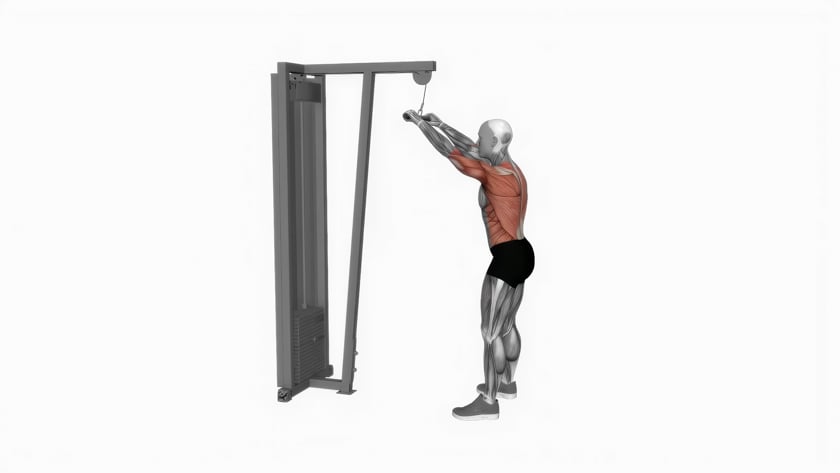
The Cable Straight Arm Pull-down is an excellent isolation exercise that strengthens the latissimus dorsi while improving shoulder stability and upper-body pulling mechanics.
Unlike traditional pulldowns, the elbows remain nearly straight throughout the movement, placing greater emphasis on the back muscles rather than the biceps.
This exercise is commonly used to develop a stronger mind-muscle connection with the lats and serves as an effective accessory movement for pull-ups, chin-ups and other back exercises.
How to Perform
Stand facing a high cable pulley with a straight bar or similar attachment.
Grasp the bar with an overhand grip approximately shoulder-width apart.
Step back slightly so the cable remains under tension, keeping your feet about shoulder-width apart and your knees slightly bent.
Brace your abdominal muscles, lift your chest and maintain a neutral spine.
Begin with your arms extended in front of you and a slight bend in your elbows.
Keeping your elbows nearly fixed, pull the bar downward in a smooth arc until it reaches your thighs.
Pause briefly while squeezing your lat muscles.
Slowly return the bar to the starting position under control without allowing the weight stack to slam.
Repeat for the desired number of repetitions.
Tips
Maintain only a slight bend in your elbows throughout the exercise.
Think about pulling with your back muscles instead of your arms.
Keep your chest lifted and shoulders down throughout each repetition.
Move through a slow, controlled range of motion.
Use a resistance that allows you to maintain proper technique from beginning to end.
Benefits
Effectively isolates the latissimus dorsi.
Improves upper-body pulling strength.
Enhances the mind-muscle connection with the back muscles.
Strengthens the shoulders while promoting good scapular control.
Provides an excellent accessory exercise for pull-ups and lat pulldowns.
Helps improve posture by strengthening the muscles responsible for shoulder stability.
Common Mistakes
Bending the elbows excessively and turning the exercise into a triceps pushdown.
Using momentum by rocking the torso.
Shrugging the shoulders toward the ears.
Allowing the lower back to arch excessively.
Using too much weight and sacrificing proper form.
Returning the weight too quickly instead of maintaining control.
FAQ
Safety Note
Maintain a neutral spine and avoid excessive arching of the lower back.
Keep your movements slow and controlled throughout the entire range of motion.
Do not use excessive weight that causes your torso to rock or your shoulders to shrug.
Maintain a slight bend in the elbows to reduce unnecessary joint stress.
If you experience pain in your shoulders, elbows or lower back, discontinue the exercise and consult your physician or another qualified healthcare professional before continuing.